

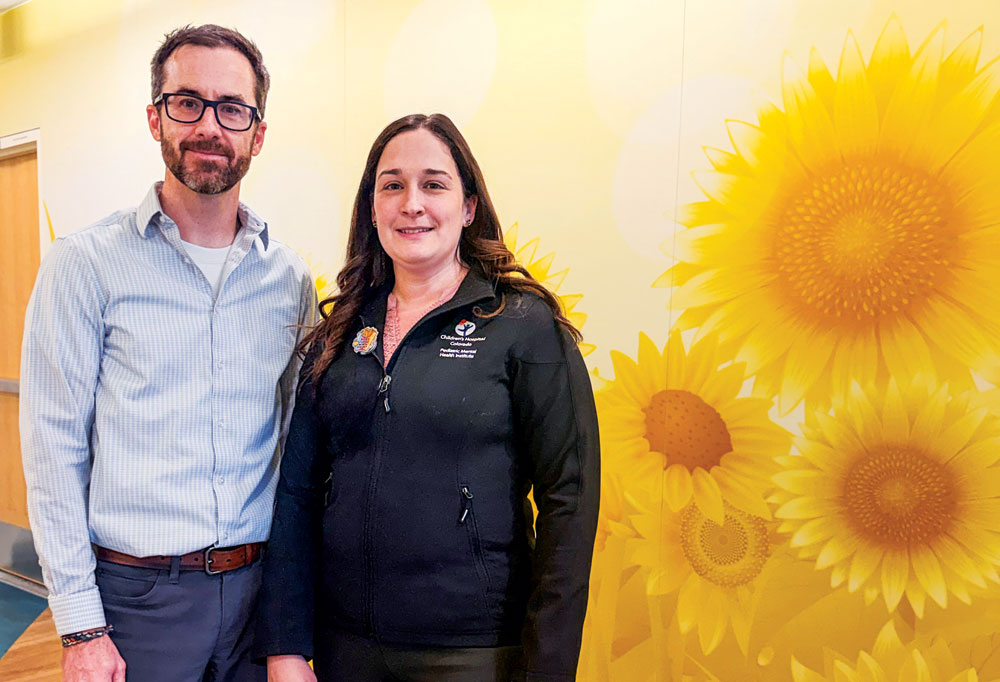
Pediatric psychologists Benjamin Mullin and Kimberly Sheffield from Children’s Hospital Colorado.
Six years after Covid shut down classrooms, anxiety rates among children have not returned to pre-pandemic levels, according to psychologists at Children’s Hospital Colorado, and youth are seeking more mental health support than ever before.
“We are definitely seeing a rise in mental health concerns—very much including anxiety,” said Stefanie Lowy, school social worker at DSST Conservatory Green High School in Central Park.
At least one-third of middle and high school students will meet the criteria for an anxiety disorder at some point in their adolescence, noted Benjamin Mullin, PhD, a pediatric psychologist and director of the Colorado OCD and Anxiety Program at Children’s Hospital.
“We’re still experiencing the legacy of the Covid period,” he said. “Students missed out on a lot of the social development that they needed, and they’re still struggling to put it back together.”
Responding to the long-recognized link between anxiety and related disorders, Children’s Colorado will launch a new outpatient clinic focused on anxiety and eating disorders in early 2026.
Also in response to mounting concerns, some high schools notified families in the fall that suicidal ideation has increased among teens and urged parents to watch for signs of anxiety and depression. Most Colorado schools survey students twice a year for mental health disorders, and counselors regularly provide in-classroom suicide prevention trainings and social and emotional support. School psychologists and social workers meet individually with students who are identified as anxious and lead group therapy for a variety of mental health concerns.
While anxiety is “totally normal and healthy for people to experience,” Mullin said, persistent worrying that interferes with a child’s ability to function comfortably in daily life is categorized as a mental health disorder. Youth with anxiety may stop participating in school or initiating friendships, retreat from activities, have trouble sleeping or concentrating, complain of physical pain, seek frequent assurances, or seem more irritable.
What can be difficult for parents and educators is that anxiety can present as “normal middle schooler behavior,” said Jill Wilschke, PhD, school psychologist at McAuliffe International School in Park Hill. She explained, “Anxiety can look like defiance or refusal, especially when a child is trying to avoid something that feels overwhelming. To others it can look like being oppositional.” Although anxiety can become detrimental at any age, students are especially vulnerable during puberty and through their teen years.
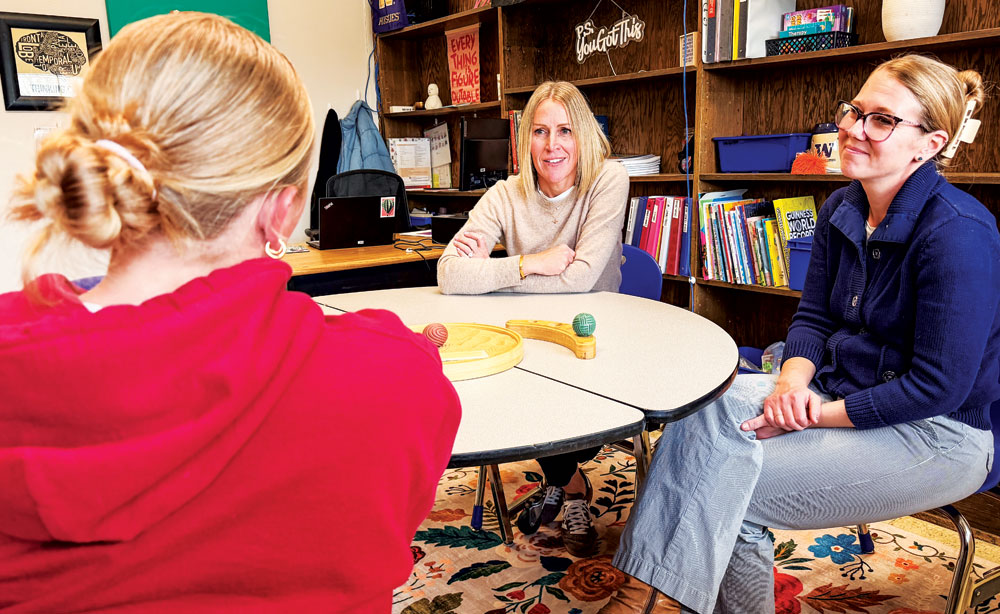
School psychologist Jill Wilschke (middle) and counselor Kelly Knapp (right) meet with a student at McAuliffe International School.
Part of the problem, said Lowy, is that “there is a dearth of coping skills.” Students “turn to their phone as a source of distraction,” and scrolling social media “leads to comparing themselves to others or to online conflict.” Worse, students may adopt maladaptive coping techniques they’ve seen on Snapchat or TikTok, she said, and may self-harm to numb their feelings.
The good news is that young people are often eager to learn positive coping skills to control their anxious thoughts.
Mullin said, “The research is very clear: Cognitive behavioral therapy—that is time-limited, very goal-based, and skill-based—works.” He added, “This is a collaborative practice that you do with a therapist where you progressively approach situations that provoke anxiety.” He has seen many of the best outcomes in children who both engage in CBT therapy and use medication.
At the OCD and anxiety program he directs, “the science is taken very seriously,” Mullin said. “We stick close to what we know and design all of our programs around that.” Programs range from group and one-on-one outpatient therapy to intensive sessions that last several hours multiple days a week. In the most severe cases, hospit- alization may be medically necessary.
For those navigating anxiety alongside an eating disorder, Kimberly Sheffield, PhD, a pediatric psychologist and expert in disordered eating at Children’s Hospital, recommended a family-based treatment model.
“Parents are the experts on their kids, and if something feels different or strange, the sooner we act, the better the outcome,” she said. Youth with anxiety who are treated within the first three years of the onset of an eating disorder are most likely to recover fully.
“It is never too late to receive treatment,” Mullin said. “It will alter the trajectory of their lives.”
As students who lived through the Covid pandemic develop coping skills, “they are learning those skills as the conversation about mental health has become more normalized,” Lowy said. “I am very hopeful that these kids are set up for success not just academically but with the life skills for managing emotions and dealing with stressors that are going to come as they face the real world.”
Mullin and Sheffield are optimistic, too. “The increased awareness with the decreased stigma is one of the most hopeful signs,” he said.
If you or someone you love are having thoughts of suicide, resources are available:
- The National Suicide Prevention Lifeline provides support and resources. Call 988, text 988, live chat at 988colorado.com, or visit speakingofsuicide.com.
- Colorado Crisis Services offers immediate mental health, substance use, and crisis support. Call 1-844-493-TALK (8255) or text TALK to 38255.
- The Trevor Project offers LGBTQ+ youth crisis and suicide prevention support. Call 1-866-488-7386 or text START to 678678.
- Imattercolorado.org connects anyone age 18 or younger with free therapy for anxiety or other mental health concerns.
Front Porch photos by Christie Gosch
0 Comments