

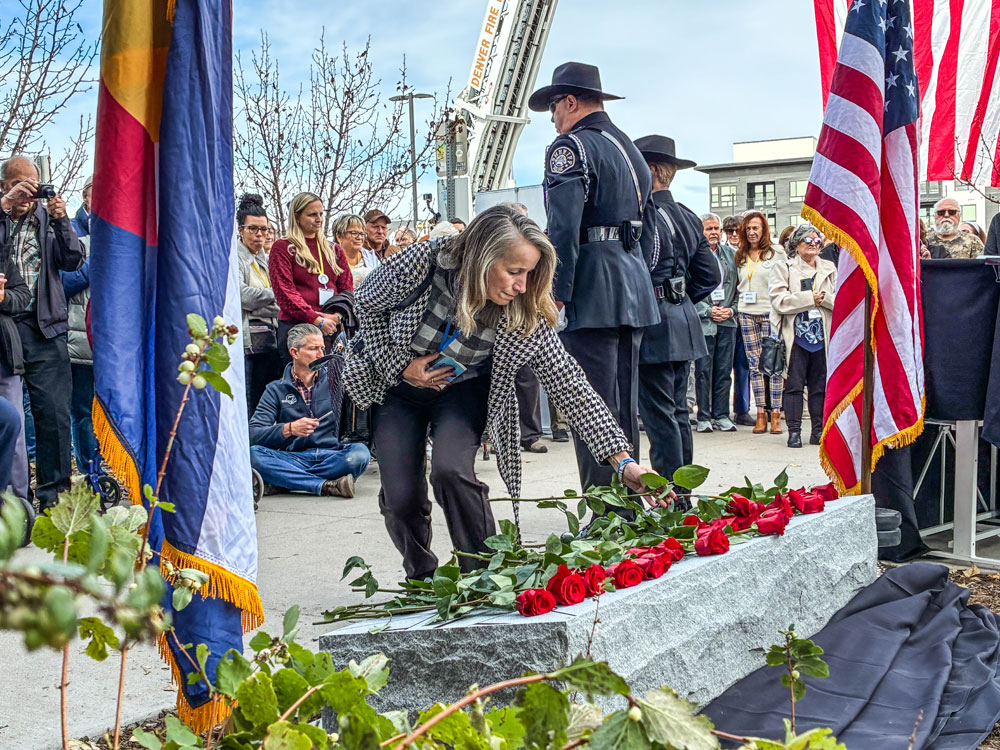
Family members laid roses on the memorial to honor victims of Flight 629 at FlyteCo Tower in Denver. Photo by Mary Jo Brooks
Seventy years after a bomb on United Flight 629 killed all 44 people on board, a granite memorial was dedicated at the site of the former Stapleton air traffic control tower, where the flight originated. The explosion occurred 11 minutes after takeoff over a field in Weld County. Investigators later determined it was caused by 22 sticks of dynamite hidden in the luggage of a woman whose son had purchased a life insurance policy at the airport. The tragedy marked the first large-scale act of sabotage on a commercial airliner in the United States.
Speaking at a ceremony inside FlyteCo Tower, Denver Mayor Mike Johnston said the memorial was long overdue but “what is important now is that we tell the stories of every one of those 44 lives.”
That was exactly what motivated Mike Hesse to plan, fundraise, and orchestrate both the memorial and a weekend of activities that brought more than 100 family members of the victims together on the Nov. 1 anniversary. “Many people don’t know about this tragic event, or they just know the perpetrator’s name but didn’t know the victims’ names. That didn’t seem right to me,” said Hesse, a self-described history buff.

The granite memorial for the victims includes the outline of an airplane pointed in the direction of the flight path of Flight 629 on Nov. 1, 1955. Front Porch photo by Christie Gosch
At the ceremony, family members came forward to lay a single rose for each name engraved on the surface of the stone. Kate Edwards Mullen attended in honor of her grandparents, who perished in the crash. She was just two years old when they died. They had been on their way to Hawaii to visit her family since her father was stationed at Pearl Harbor.
“I didn’t think about it for much of my life. My parents didn’t speak about it. So, I was on the fence about coming,” she said. “But being here has been transformative. I came with two cousins, and it just feels so right to have a memorial for them [the victims].”
Susan Morgan, who lost both of her parents in the explosion, expressed what many others said: A kinship was formed with the other family members who came to the dedication ceremony. “I’m among a large group of people whose lives have been scarred by the same tragedy as mine,” she noted.
A native of Denver, Hesse said he first learned of the crash when he was in high school and took a tour of the FBI Museum in Washington, D.C. On display was a portion of Flight 629’s fuselage. Hesse, whose father was a police officer, helped create the Denver Police Museum, which now houses that same fuselage part (although it is currently on loan to the History Colorado Center).
Hesse explained that, in addition to the victims of the flight, he wanted the dedication weekend to recognize local police officers, FBI agents, and prosecutors who brought the perpetrator to justice. At the time of the explosion, commercial air travel was still relatively new—Flight 629 was the first flight for many passengers on board—and there were no federal laws against such acts of terrorism or established procedures for investigating them. Flight 629 would change all of that.
“There wasn’t much technology back then, so it involved a lot of old-fashioned shoe leather,” Hesse said. Investigators at the federal and local level worked together to comb the six-square-mile area of the crash and then re-assemble the fuselage in a large warehouse near the airport to determine the cause.
0 Comments