

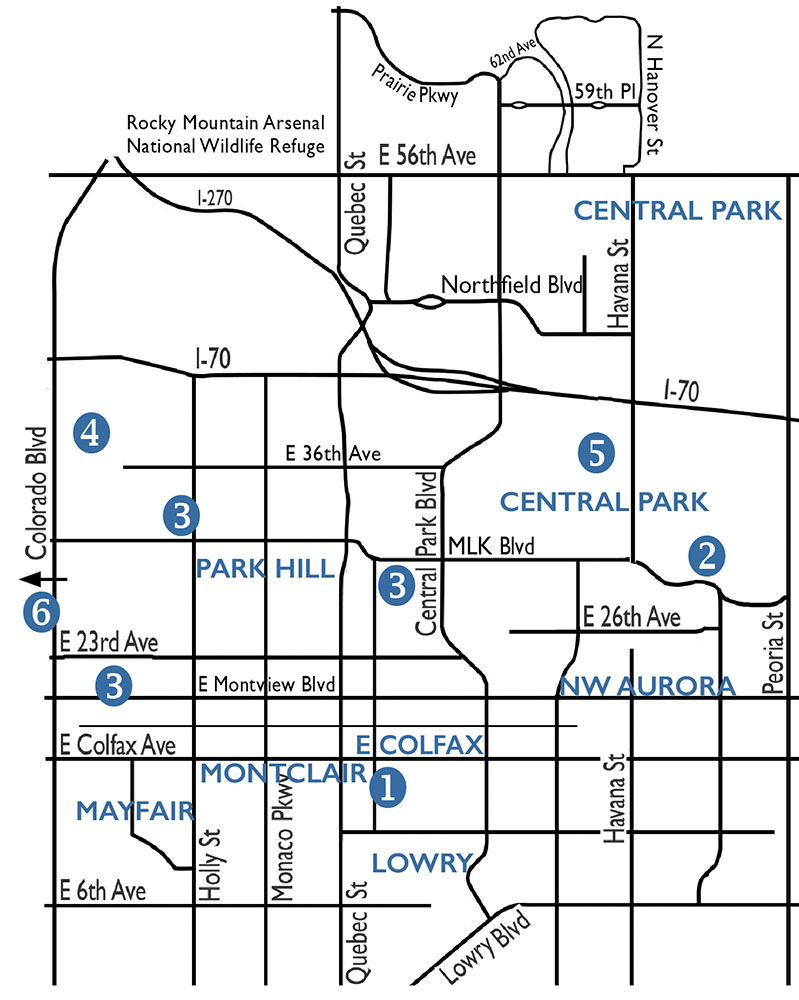
1) The Denver Debate Over Flock Cameras
Denver City Councilmember Sarah Parady has called on Mayor Mike Johnston to stop Denver’s use of Flock cameras, a type of automatic license plate reader from the company Flock Safety.
Denver Police have said the cameras, installed at dozens of locations across the city, have helped to reduce car thefts and aided in solving other crimes. But Parady and neighbors who attended a recent East Colfax Neighborhood Association meeting voiced concerns about privacy and voted not to support the addition of a new camera planned for the intersection of 14th Avenue and Syracuse Street.
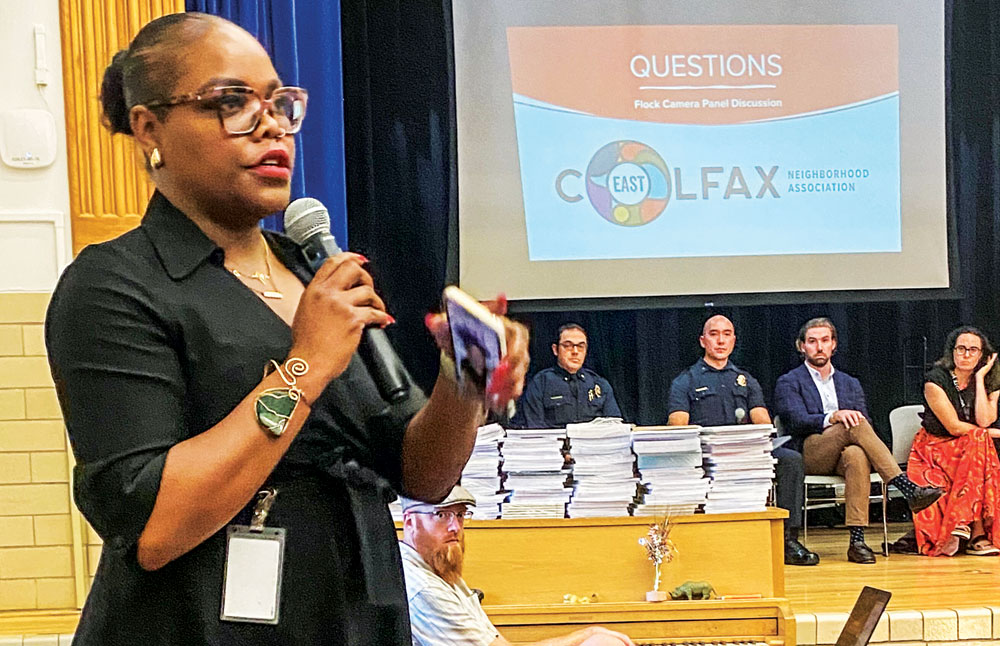
Denver City Councilmember Shontel Lewis speaks at a meeting of the East Colfax Neighborhood Association about Flock camera use. Front Porch photo by Linda Kotsaftis
Denver Police Commander Jacob Herrera said the cameras were brought to the city to help reduce auto thefts, and DPD later found other benefits.
“The system has been used to solve murders, to solve sex assaults, to solve shootings, to interrupt in real time robberies where suspects were hitting multiple 7-Elevens, robbing them at gunpoint, stealing other cars,” Herrera said.
But Parady said the cameras also recognize vehicle makes and models, everything down to bumper stickers. And that, she said, creates a privacy issue with the images and the database that stores them.
Parady said the stored information may have been used to assist federal immigration officials, and neighbors at the meeting voiced concerns about how the data is used. Denver Police said they have turned off the ability for national searching of the local database of information.
Parady, along with Councilmember Shontel Lewis, questioned the money spent on the cameras, which the council voted down in May but was later approved by the mayor’s office. A task force has been formed between the Denver City Council and the mayor’s office to look at the program and how it’s managed.
2) A Big Step Forward for Construction at Bluff Lake Nature Center
Work has come a long way since the groundbreaking of the construction project at Bluff Lake Nature Center (BLNC) in March. In late August, staff, donors, and volunteers signed a large board to be lifted into place at the topping-off ceremony.
Offices, meeting rooms, multi-use classrooms, and bathrooms are part of the improvements meant to enhance community access with a welcoming space, as well as to create a headquarters for the BLNC team, which currently works a few miles away.
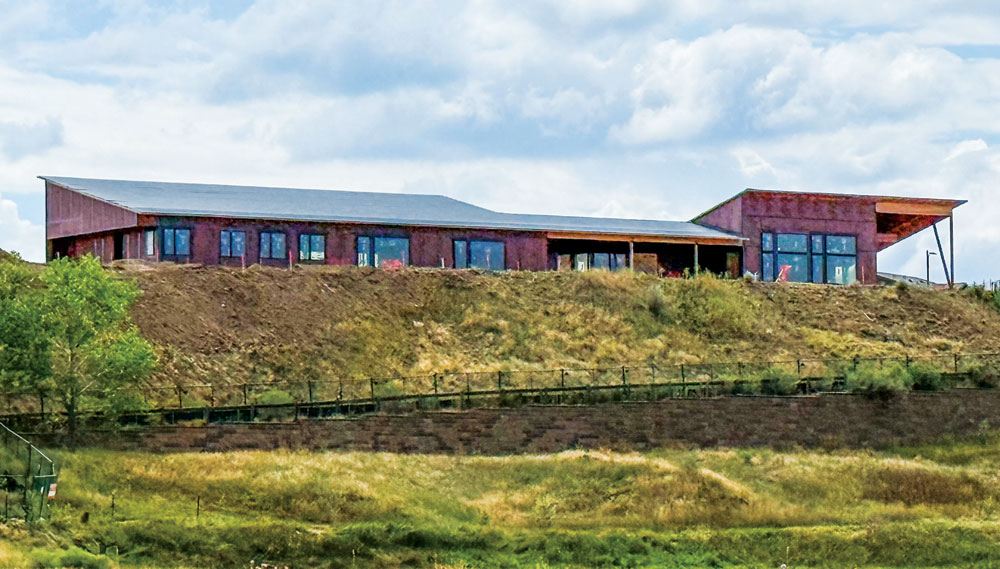
The new building at Bluff Lake Nature Center. Front Porch photo by Linda Kotsaftis
“We love this space and this organization and truly believe that this project provides us an opportunity to be even better stewards of this land,” said Rachel Hutchens, BLNC executive director. “This new space will make Bluff Lake more accessible, less logistically challenging for families and groups, and will truly bring our team on site in a way we’ve never had before.”
Hutchens said the building is expected to open in December, with the new parking lot and accessible ramp installed shortly after that.
The 123-acre wildlife refuge, located at the east edge of the Central Park neighborhood, has seen the numbers of visitors grow as development in the area has increased. BLNC reported 100,000 visitors in 2024 during its 30th anniversary year.
Construction began on the $8.5 million campus improvement project in March.
3) Denver Provides Free Narcan and Overdose Response Training at Local Libraries
Free naloxone (the generic for Narcan) is now available at all Denver Public Library (DPL) locations, and overdose response training will be available at the Denver Central Library.
The Denver Department of Public Health & Environment (DDPHE) has joined DPL in offering resources and training so that people can recognize the signs of an opioid overdose and safely administer naloxone.
“Overdose prevention isn’t just about one person or organization. It’s also about neighbors looking out for one another, education, and making lifesaving resources accessible when and where they’re needed most,” said Mayor Mike Johnston in a press release. “By placing overdose prevention tools and training in our libraries, we’re reinforcing their role as pillars of safety, care, and opportunity in Denver’s communities.”
According to a press release, research shows naloxone access can reduce overdose deaths by as much as 65%, which gives programs time to connect more people to treatment, housing, and healthcare.
Naloxone doesn’t work on non-opioid substances like methamphetamine or cocaine. According to DDPHE, administering naloxone to someone who is not experiencing an opioid overdose does not cause harmful effects.
4) City Gathers Public Input on Park Hill Park and Other Neighborhood Needs
Officials from the City of Denver held an open house on Sept. 13 to gather input for the design and amenities that may be included in the new Park Hill Park (formerly the Park Hill Golf Course). It was the latest in a public participation process that was initiated in April. On display in the Hiawatha Davis Jr. Recreation Center were large-scale aerial representations of the park. Visitors could place cut-outs depicting tennis courts, pavilions, ballfields, and other amenities on the board to help envision what the park could look like.
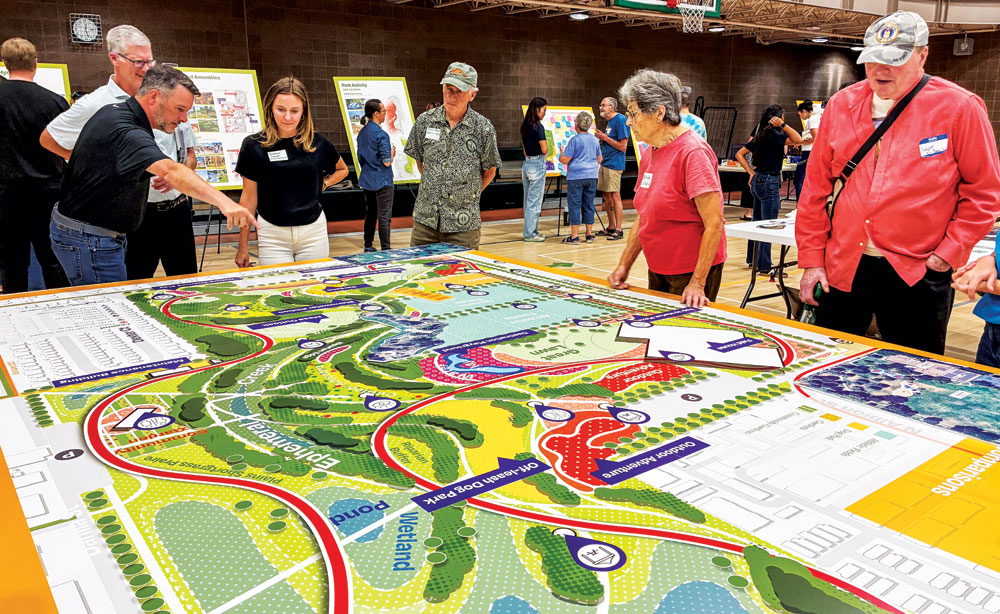
Gordon Robertson, director of planning, design, and construction at Denver Parks & Recreation, points to a mock-up of a large city park. The department held an open house in September to solicit feedback from Denver residents about the amenities they would like at the new Park Hill Park. Photo by Mary Jo Brooks
“We’re in this phase of asking people to think big,” said Stacie West, city-wide planning supervisor at Denver Parks and Recreation. “What does it take to build a really great park?” To help answer that question, West and her team have been studying what other cities around the country have done. West said Park Hill Park will be the largest park to be built in Denver in over 100 years.
Two years ago, Denver residents voted to keep the 155-acre parcel as a green space rather than have it developed into residential and commercial spaces. One of the main arguments for development had been the lack of affordable housing and grocery stores in the area, so officials at the open house were also seeking public input on those issues. “The top three priorities we’ve heard from the community are affordable housing, reducing displacement pressures that can happen when big investment comes in, and access to fresh food,” said Sarah Showalter, Denver’s director of planning services. “There’s only so much a city government can do, but we want to identify strategies that the City and other partners can pursue to see those goals accomplished.”
Rev. Eugene Downing from New Hope Church, located at the edge of the park, was at the event to learn more. Although he had voted for the development plan, he was encouraged by what he saw. “I’m excited that there is real thoughtfulness about getting community input,” he said. “I think the mayor’s team is really sincere about that.”
Another open house will be held in November. In the meantime, the public can learn more and make suggestions at parkhillpark.org.
5) New Mural Sprouts along the Sand Creek Regional Greenway
Volunteer artists of all ages were out painting a giant paint-by-number depiction of the flora and fauna that live in the area at the third annual Sand Creek Regional Greenway Mural Festival in September. Artist Catie Michel’s design was chosen from among 23 entries. Trained as a scientific illustrator, Michel said she loves working with the public in this manner. “I want the community to really have ownership of this mural,” she said. The 264-foot-long painting will portray five field note entries featuring birds, mammals, reptiles, plants, and aquatic habitat. “Already I’ve seen so many species first-hand that are in the mural. A red-tailed hawk has visited every day,” Michel added.
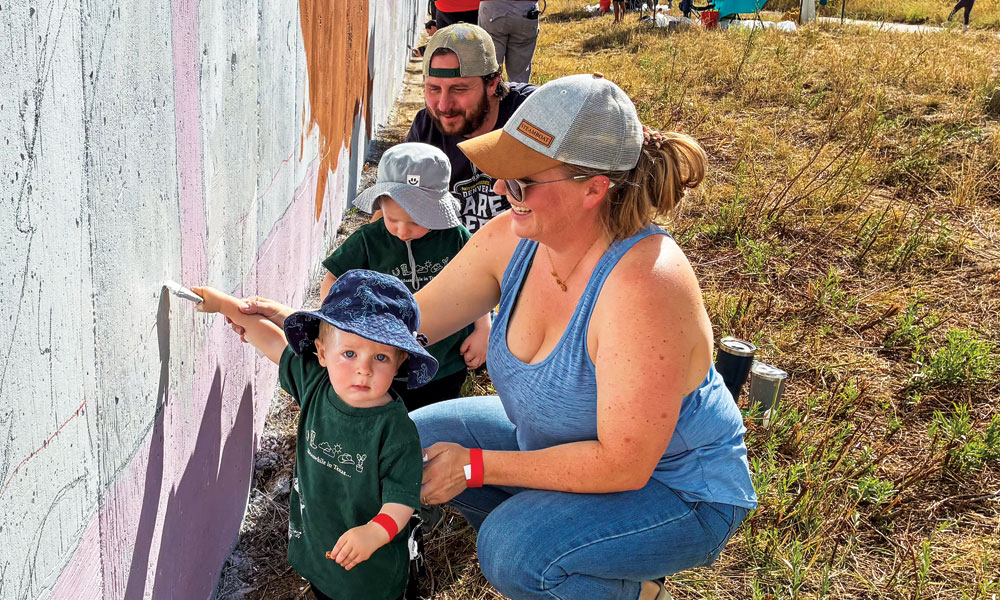
Volunteer artists dab paint on a new mural along Sand Creek. Photo by Mary Jo Brooks
Le’alani Boykin is the director of special projects at the Sand Creek Regional Greenway Partnership. She said the mural is “a wonderful representation of what this community values. This is a very special piece of nature along a 13-mile corridor in an urban area.”
Michel hopes to complete the mural by mid-November. To learn more, visit sandcreekgreenway.org/artwalk.
6) Alumni Center Opens at Manual High School
A new alumni center has opened at Manual High School thanks to Friends of Manual, an organization that raises funds to provide extra support for students and teachers. The center showcases newspaper clippings, photographs, and other memorabilia highlighting the rich history of one of Denver’s oldest schools. Founded in 1892, Manual is located in the historically African American neighborhood of Whittier.
“The school has an incredible history,” said Mary Salsich, chair of Friends of Manual. “Initially the student body was mostly Black, and later many Japanese American students arrived after the internment camp closed. Then busing brought in white students as well. We want to capture all of that richness and diversity.”
To preserve those stories, Salsich has begun recording interviews with alumni for an oral history project. She hopes Manual graduates will contribute memorabilia and volunteer to help staff the new center.
0 Comments