


During the Shift2 pilot program, Ricardo Maestas used his e-bike to commute. Front Porch photo by Christie Gosch
For Ricardo Maestas, the toughest part of cycling more and driving less is “getting out of bed,” especially on a cold morning when he needs extra time to bundle up before hopping onto his bike. But once he’s commuting to downtown Denver on his bicycle, “you’re very happy that you did it,” he said.
Maestas is one of 800 people who live or work in Denver who joined the Shift2 pilot program this fall. The mobility incentive program, offered by the Denver Office of Climate Action, Sustainability, and Resiliency (CASR), asked participants to “shift” two single-occupancy car trips a week to biking, walking, carpooling, or public transportation. Participants could earn up to $100 for completing the program, with additional cash prizes available.
CASR designed the pilot with an ambitious goal. “We ran the pilot program for 10 weeks because that is about how long it takes to change habits—and change lives,” said Sue Baldwin, CASR’s electrified mobility program manager.
This month, the agency is rolling out the official Shift2 program, which will include all of Denver and run through December.
The 2026 program, called Shift2 like the pilot, combines incentives and gamification through a friendly competition among neighborhoods. CASR has grouped Denver neighborhoods into nine teams, and participants can earn points for shifting at least two car trips per week to a more sustainable mode. Trips are tracked through an app from the Denver Regional Council of Governments, and anyone age 18 or older who lives or works in Denver can compete.
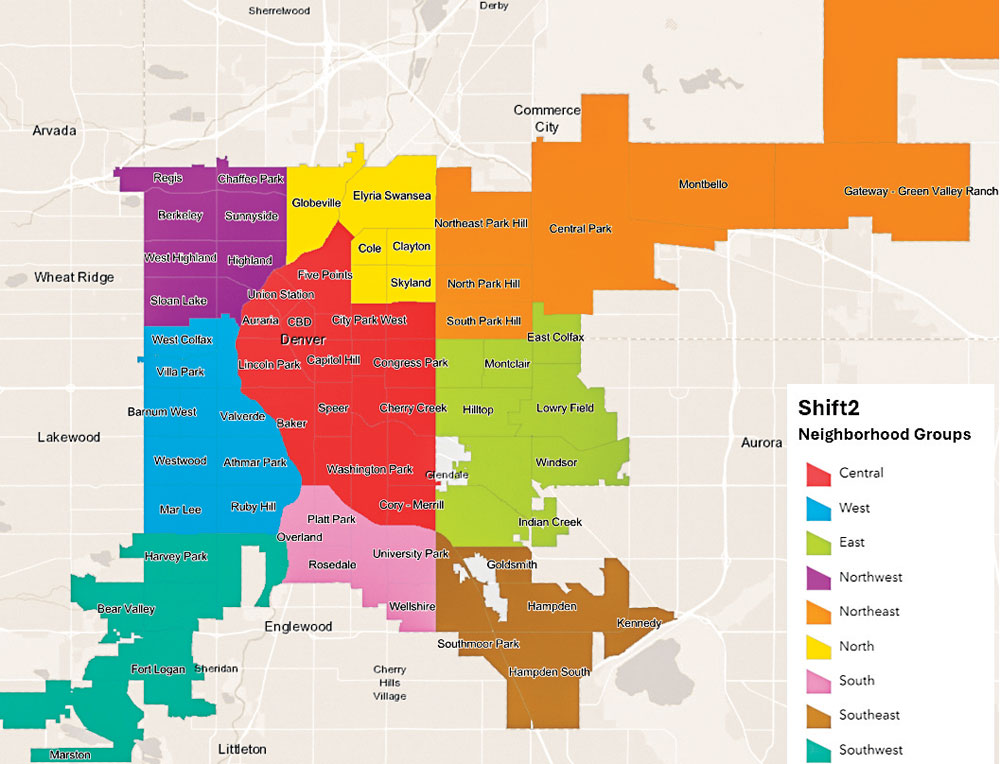
For the competition, the Climate Action, Sustainability, and Resiliency agency grouped Denver neighborhoods into nine teams. Illustration courtesy of the Denver Office of Climate Action, Sustainability, and Resiliency
CASR is partnering with local businesses and business improvement districts to offer prizes, such as two-for-one deals at neighborhood coffee shops, in addition to monthly prize drawings.
“This is all about making a behavior change,” Baldwin said. “So, when you walk into your garage, you’ll say, ‘Do I really need to drive, or can I walk or ride my bike for this trip?’”
Although Maestas owned an e-bike before joining the pilot, Shift2 “provided a boost in accountability,” he said. “I was tracking my trips and could see the numbers going up.” He logged about 500 miles over 10 weeks commuting from home to his shared workspace. On snowy or rainy days, he sometimes shortens his ride by using the light rail.
Maestas hopes to cycle through 2026 and beyond. “I enjoy the energy boost that comes from being more active and spending time outside, getting my Vitamin D,” he said.
Baldwin added with a smile, “Let’s shift your trip. This is an opportunity to explore new areas and win prizes with your neighbors.”
0 Comments