


Community engagement specialist Chris Callanan answered questions about Denver’s new Sidewalk Enterprise Program at a District 5 open house in February. Front Porch photo by Christie Gosch
It’s an enormous task: fixing or upgrading more than 1,400 miles of sidewalks and constructing 318 miles of new ones within the next decade. The effort is part of the city’s Sidewalk Enterprise Program, launched after Denver voters approved a 2022 ordinance to create a dedicated sidewalk fund supported by property owner fees. Last year, most homeowners began paying a $150 annual fee that goes directly into a sidewalk construction fund.
Program director Geneva Hooten said the initiative is ambitious. “What is very unusual is that this program has dedicated funding and a very narrow scope to do something at a scale and pace that no other city in the United States has done.”
Before the measure passed, sidewalk maintenance was largely up to individual property owners, a system that often left cracked or missing stretches untouched for years. Now the city is responsible for repairs and upgrades, with the goal of consistently maintaining and creating safer, more access- ible routes for pedestrians in every neighborhood.
Work began last summer, with crews repairing 5.5 miles of sidewalks in Berkeley, Sloan’s Lake, and Capitol Hill, among other areas. Unusually mild temperatures have allowed construction to continue throughout the winter.
The city is expected to spend $40 million on sidewalk repairs in 2026, with the East Colfax neighborhood slated for upgrades. As the 2026 workplan is finalized, repair schedules and locations will be announced.
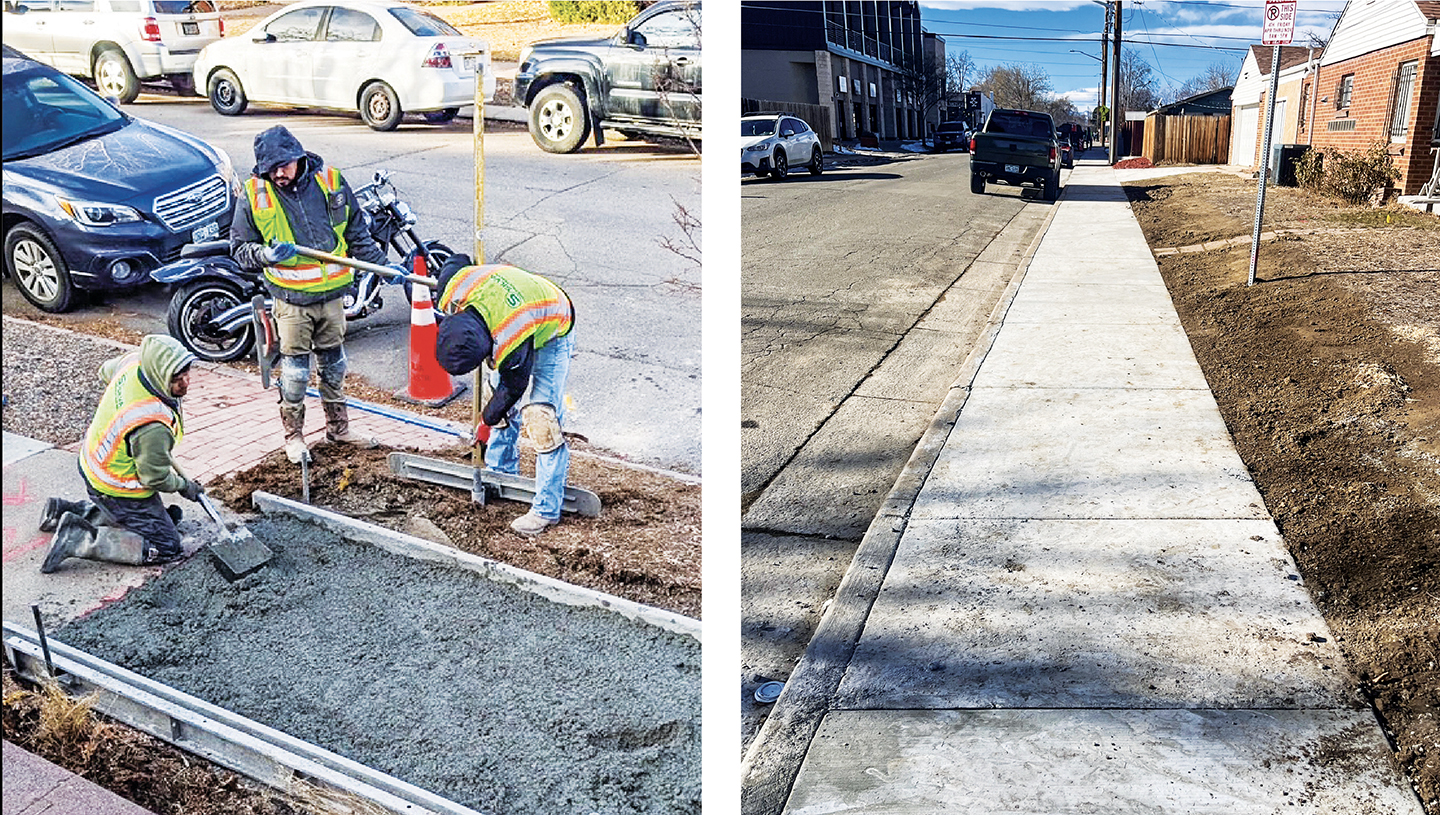
Workers repair a section of damaged sidewalk in February, and a new sidewalk was constructed along E. 29th Ave. Photos courtesy of the City of Denver
While those projects are underway, the city’s Department of Transportation and Infrastructure is developing a sidewalk implementation plan that will outline a long-term framework for prioritizing which areas need the most immediate attention. The city has been holding town hall meetings to answer questions and get public input.
Officials are also encouraging Denver residents to fill out a survey to help guide the process. “This is democracy in action,” said Hooten. “It is vitally important that we are hearing from people all across Denver and taking their considerations into the process.”
During a tele-town hall in February, many residents had questions and concerns about how invasive the construction would be and who would be responsible for any damage done to a homeowner’s property. Standard sidewalks are required to be five feet wide, and sidewalks along major arterial roads must be eight feet wide, which means fairly extensive construction will be necessary in areas with narrower or non-existent sidewalks.
Hooten said city officials will give homeowners a 90-day notice before projects begin, and the city will be responsible for damages incurred. She explained, “The guiding principle is if any new sidewalk construction or widening or repair work damages existing irrigation systems, our construction crews will fix, repair, and restore those to the condition that they were in.”
In the coming year, $10 million will be spent on a Field Fit pilot project to build new sidewalks where none previously existed. Eligible Field Fit sites require less design and construction time because there are fewer trees, utility poles, and other infrastructure that must be relocated or removed for the sidewalk construction. Sites with those existing impediments can require more than a year of planning and design time.
When Denver’s sidewalk system is fully built out, it is expected to cover approximately 3,458 miles. As the city’s website notes, that’s “about the distance from Denver to New York City and back again.”
Hooten is well aware of the enormity of the task ahead. “The code says we are compelled to build out this network in nine years or as soon thereafter,” she said. “So we know that we need to act with urgency. We know that we have to act at a scale that we haven’t done before.”
For more information or to fill out the survey before the March 14 deadline, visit denvergov.org/sip
0 Comments