

As we close out the growing season, I wanted to say thank you to Front Porch readers for their enthusiastic response to July’s column. We received much inspiration to redo tree lawns.
Mickey Siegel suggested keeping weeds out with clover and large pavers, while Anne Hazelton found success with creeping thyme, a groundcover that produces purple hues.
Kelsey Myron-Karels used the “garden in a box” program through Denver Water to help spruce up the family’s tree lawn, using mostly native plants. And Beverly Morlock used a vibrant mix of xeric plants that includes such Colorado natives as coneflower, little bluestem grass, and pentstemon.
The feedback we’ve received led me to focus on a practice that, if taken up throughout our neighborhoods, would have a notable impact on the climate: growing native plants.
My own introduction to native plants began a few years ago in early spring. I noticed European honeybees flocking to the dandelions that had popped up in our yard and posted my appreciation for the weed on social media. I expected to stir a little controversy but wanted to encourage folks to avoid spraying pesticides. My former colleague, Jonathan Sciarcon, kindly noted that early bloomers like pasque flower or chokecherry would be more nutritious, and would sustain many pollinators.
The Front Range chapter of Wild Ones, a volunteer-run advocacy group and a tremendous resource, defines a native plant as a species that naturally occurs in a particular region, ecosystem, or habitat that was present in North America prior to European colonization. Key to defining native plants is the idea that they evolved in an area for a very long time.
Sciarcon, the inaugural host of the Front Range Wild Ones podcast, Coloradoscape, explained that native plants offer a more “nutrient dense” option for supporting pollinators without intensive water use: “They can fill every local ecosystem need and not just a few.”
Take one of the few trees native to our area, the cottonwood. Fossilized leaves of cottonwoods dating back 47 million years have been found in Utah’s Uinta mountains. The tree hosts hundreds of caterpillar species, which Sciarcon said, are crucial to birds’ ability to rear young. In fact, cottonwoods provide habitat for 82 percent of Colorado’s bird species. Cottonwood trees—like the grand grove lining Greenway Park—provide not only shade and beauty but anchor a web of life through food and shelter.
As the Audubon Society explains, the continental U.S. has lost 150 million acres of farmland and habitat to urban development, a process that has converted diverse plants evolved in their area to landscapes dominated by non-native plants (like butterfly bushes or Asiatic pear trees that may grow fast, but do not sustain the food web as well as rubber rabbitbrush or cottonwood).
Along with restoring the food web of our area one patch at a time, native plants save precious resources. Because their ancestors have lived through lots of climatic ups and downs, many native plants require less water and upkeep.
Sciarcon shared several ideas for Coloradoscaping your tree lawn, including the Colorado state grass, Blue Grama, which survives on eight inches of precipitation per year. Narrow-leaf coneflower is a shorter, more drought-tolerant option than its cousin (purple coneflower). And Sciarcon suggests planting common blanketflower, which blooms from June through September. Check out the Colorado Native Plant Gardening Facebook group, as well as the Colorado Native Plant Society and Denver Audubon Society for more information on Coloradoscaping and the High Plains Environmental Center for locally-sourced native plants.
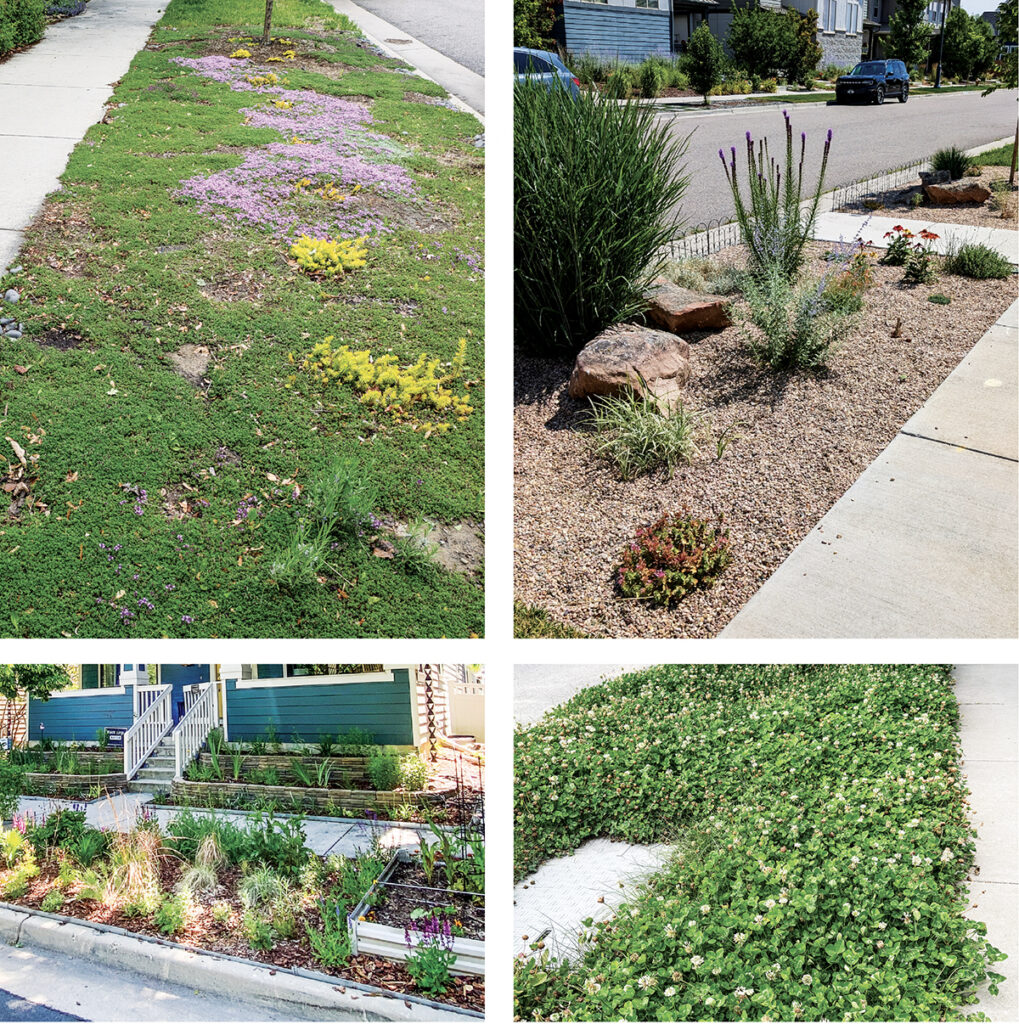
From top left, clockwise: Anne Hazelton’s creeping thyme groundcover; Beverly Morlock’s mix of coneflower, little bluestem grass, and pentstemon; Mickey Siegel planted clover to choke out weeds; and Kelsey Myron-Karels’ tree lawn consists mostly of native plants. Photos courtesy of the home owners
0 Comments