

By Christina Foust, PhD
Environmental activist Greta Thunberg said climate change “is both the easiest and the hardest issue we have ever faced. The easiest, because we know what we must do. We must stop the emissions of greenhouse gases. The hardest, because our current economics are still totally dependent on burning fossil fuels and thereby destroying ecosystems in order to create ever- lasting economic growth.”
One of the easiest and hardest ways for us to address environmental catastrophe is to ditch the car.
International Energy Agency data from 2018 shows that transportation emits 21% of total greenhouse gas emissions, with passenger vehicles responsible for 45% of road emissions. Getting people from point A to point B (by car, truck, or bus) leads to 15% of total CO2 emissions.
Car culture is part of a larger fossil fuel economy that supports the wealth of the wealthiest. Eight of the world’s largest petroleum companies totaled $27.14 billion in profits for 2025. This puts their profit margins above the GDP of 125 countries. A lot of powerful people benefit from this system as it is, and not just because it gets them from A to B. Fossil fuels look like a smart investment, including in our own state, which ranks sixth in terms of oil and gas production.
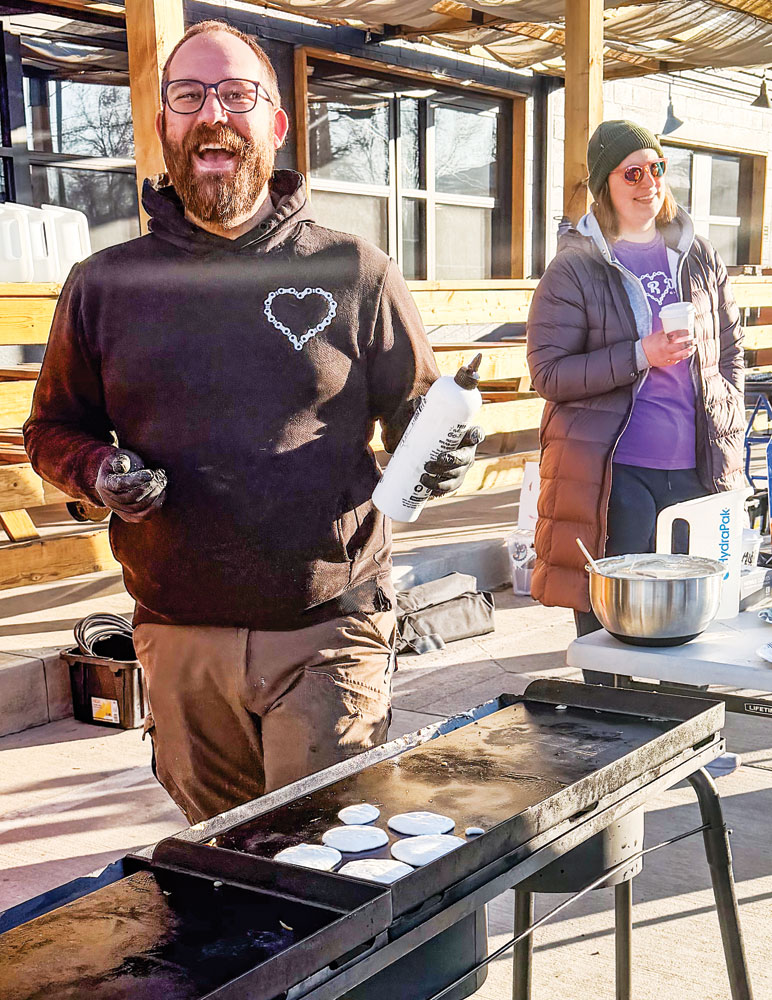
MacKenzie and Abby Hardt served pancakes to cyclists on Winter Bike to Work Day in February. Front Porch photo by Christie Gosch
But scientists estimate that tailpipe emissions ended up costing the U.S. $184 billion in 2017 because of impacts to food production, extreme weather events, and respiratory health.
I don’t want to deny the benefits that car culture brings to individuals, my family included. It would be difficult to access our work, education, and activities without a car. But now that we have a teen learning to drive, I’m seeing car culture with new eyes. There is an attitude of “pure freedom” that seems built into car culture.
I may sound like a fuddy-duddy for saying this, but I’ve been astonished by what I’ve seen in our neighborhood: Being passed on an icy street while abiding by the 25-mile-per-hour speed limit. Obscene gestures for one second of hesitation at a four-way stop. Cars are the means through which people get wherever they want to go, whenever they want to, as fast as they please.
This same attitude is on display when people sit idling their engine for 20 minutes (yes, I’ve timed) at school pick up, burning fuel without even moving. And the same attitude, I believe, has led to a record number of traffic-related deaths in Denver: 90, including 48 pedestrians, cyclists, and folks on scooters, killed in 2025.
Denver is working on safety improvements, including more dedicated and protected bike lanes. But I believe drivers can do more to resist car culture’s habit of getting you to think only of yourself. We can reduce speeds, respect traffic lights, and give space to those who are not surrounded by a ton of steel.
We can also resist car culture by getting more cars off the road. I spoke with Josh Gipper, long-time bike advocate and rider, to get his tips. Gipper encouraged us to “start small with low-stress bike routes” like the ones in Central Park and Park Hill, which are especially great for enjoying Denver’s beautiful sunsets. Gipper noted, “Bikes are the ultimate multi-tasking tool to help you unplug, get stuff done, and be active.” Make it a goal to join a family-friendly bike event this spring. Check with Hardt Family Cyclery or other local bike shops to learn about group rides.
You might also take advantage of the Shift2 program. Denver’s Climate Action, Sustainability, and Resiliency office is incentivizing residents to shift at least two of their single-occupancy vehicle commute trips per week to walking, biking, carpooling, or taking transit.
Do you have more ideas on how to save a trip? Leave the air-conditioned car behind and find me by a tree to tell me more—or drop me a line.
Christina Foust is a professor of Communication Studies at MSU Denver and co-founder of the Westerly Creek Elementary School Green Team. Email her at cfoust2@msudenver.edu or reach out on Facebook.
0 Comments