

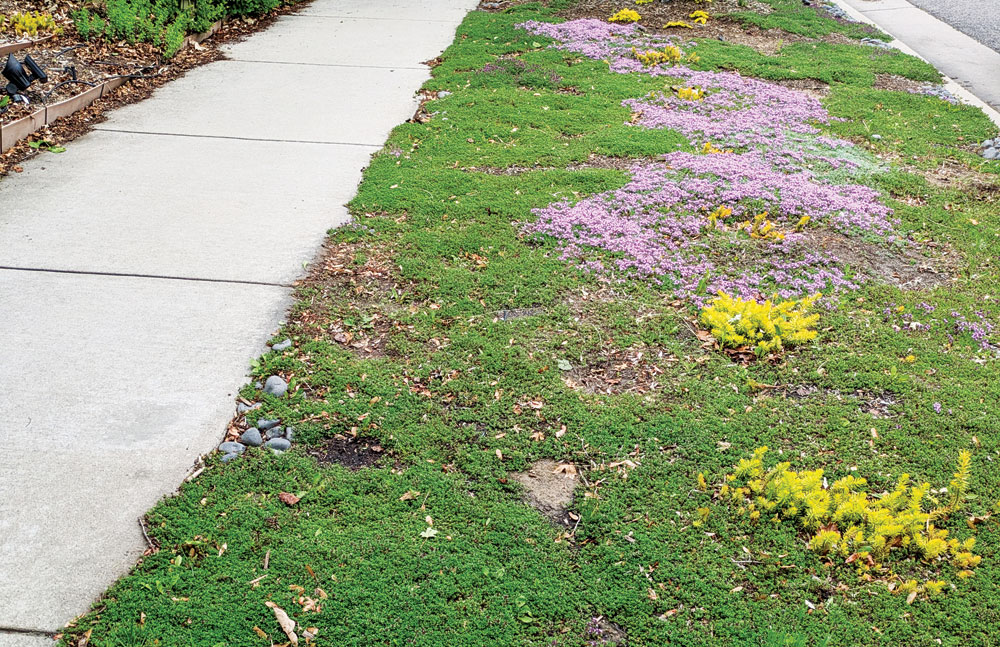
Central Park neighbor Anne Hazelton sent in a photo of the water- friendly creeping thyme groundcover she planted in her hell strip.
By Christina Foust, PhD
Professor Anthony Leiserowitz, a big figure in climate communication, describes a “perception gap” that affects climate action. “We’re sitting on an enormous potential climate movement,” he told The Guardian.
The “perception gap” suggests that people do not believe others share their opinions on climate change, nor the urgent need to act. Around the world, 89% of people believe their governments should be doing more to fight global warming. But when asked how individuals perceive others’ views, we severely underestimate, assuming that only about 40% of people are concerned about climate change. Imagine what your day to day might look like if you knew that nine out of 10 people around you were also worried about climate change. Would we be acting on it, together?
As this perception gap in climate action shows, people sometimes don’t make changes because they assume their efforts don’t matter. How could they matter on problems as massive and complicated as climate change? How could my actions make a difference if others are not making changes?
Let’s start the new year with three of the most consequential actions that neighbors can take now—if you haven’t already.
Get a Heat Pump
Replacing your natural gas furnace with an electric heat pump is one of the most important climate actions households can take. A National Renewable Energy Lab study found that households using heat pumps can lower emissions 36–64% even when they use electricity generated by fossil fuels. And with our electricity increasingly generated by renewable sources, heat pump gains will only grow. Take advantage of Denver and Colorado government incentives, as well as Xcel tax credits and discounts, in the new year.
Visit the Denver Climate Action, Sustainability, & Resiliency “Get a Heat Pump” page for more information or send me your questions and qualms about heat pumps at cfoust2@msudenver.edu.
 Practice Meatless Mondays (and Wednesdays, and Fridays, and…)
In a November 2024 column, we learned the origins of “Meatless Mondays,” revived by advertising executive Sid Lerner after a health scare inspired him to cut back on red meat. Eliminating meat one day per week saves one ton of CO2 gases annually, equivalent to driving round trip to Portland, Ore. The more days, the better the impact, and the healthier habits that get passed along to kids and neighbors. Share those bean burger recipes with me or ask me about my favorite tofu preparations.

Coloradoscape by the Foot or the Yard in ’26
I enjoyed seeing your creativity and care as we talked gardens, hell strips, and native plants in 2025. And yet, as I strolled around Central Park this fall, there were plenty of noxious weeds taking over valuable space that could be used to better nourish our native bees or migrating butterflies. This resolution is as much for me as anyone: In 2026, let’s avoid getting so busy that we succumb to landscaping with the easiest pots of plants we can find. With a little more intention (and perhaps setting an alert on my calendar), I could sign up for Denver Water’s Garden in a Box program (March) or pre-order the High Plains Environmental Center’s native plant sale (typically around April). Send me your ideas for Coloradoscaping this spring to keep me accountable and inspired!
Christina Foust is a professor of Communication Studies at MSU Denver and co-founder of the Westerly Creek Elementary School Green Team. Email her at cfoust2@msudenver.edu or reach out on Facebook.
0 Comments