

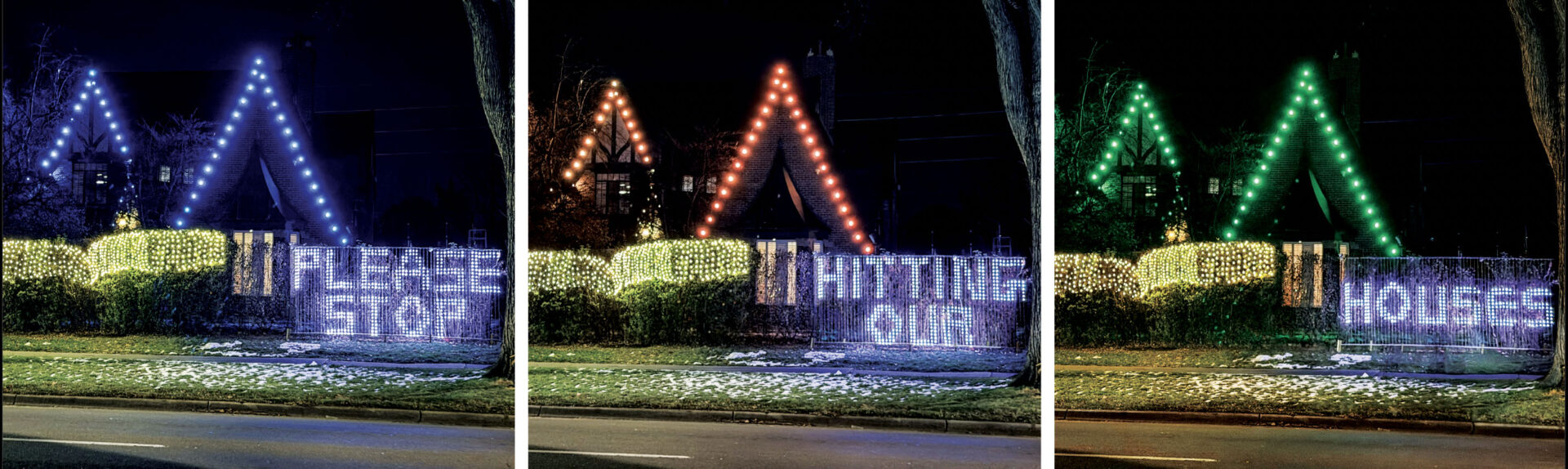
Frustrated by what they say is inaction by the city, Park Hill residents have taken safety into their own hands by installing large rock barriers and a flashing sign warning motorists to drive more carefully.
Park Hill resident Dave Stoll said he has called 911 dozens of times in response to crashes outside his home at 17th Ave. and Monaco St. Pkwy. In the last 24 months alone, speeding cars struck his house in six separate incidents, causing serious damage.
“This is a travesty. Somebody is going to be killed, either a motorist or a pedestrian,” he said. “It’s not ‘if’ but ‘when’—somebody is going to get killed.”
The problem is that cars traveling east on 17th Ave. have to make a sharp jog to the left to continue traveling eastbound. “It wasn’t designed for today’s traffic, today’s automobiles, today’s speeds,” Stoll said.
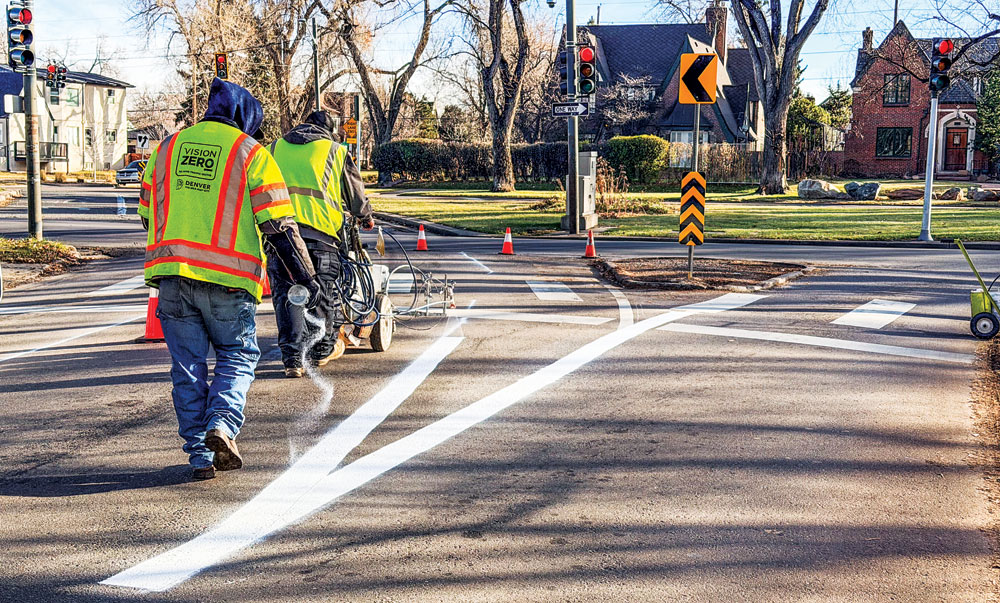
City workers installed new signs and reflective street markings in mid-December to improve safety at the intersection of 17th Ave. and Monaco St. Pkwy. Neighbors say it’s not enough.
Over the past year, about 300 Park Hill residents have come together to ramp up a campaign demanding that the city make significant improvements to the intersection. Denver City Council members Darrell Watson and Shontel Lewis held meetings with neighbors this summer, and Watson admitted he was nervous just standing in Stoll’s front yard. “It does not feel safe,” he said. “It is not a safe corridor, and that’s why we’re taking some deliberate steps to make it safe.”
The first of those steps was taken mid-December when Department of Transportation and Infrastructure (DOTI) crews installed new signs and new paint striping on the pavement to better guide motorists. “You get an early heads-up that there’s a lane shift and that through-traffic should move to the left,” said DOTI’s Maggie Thompson.
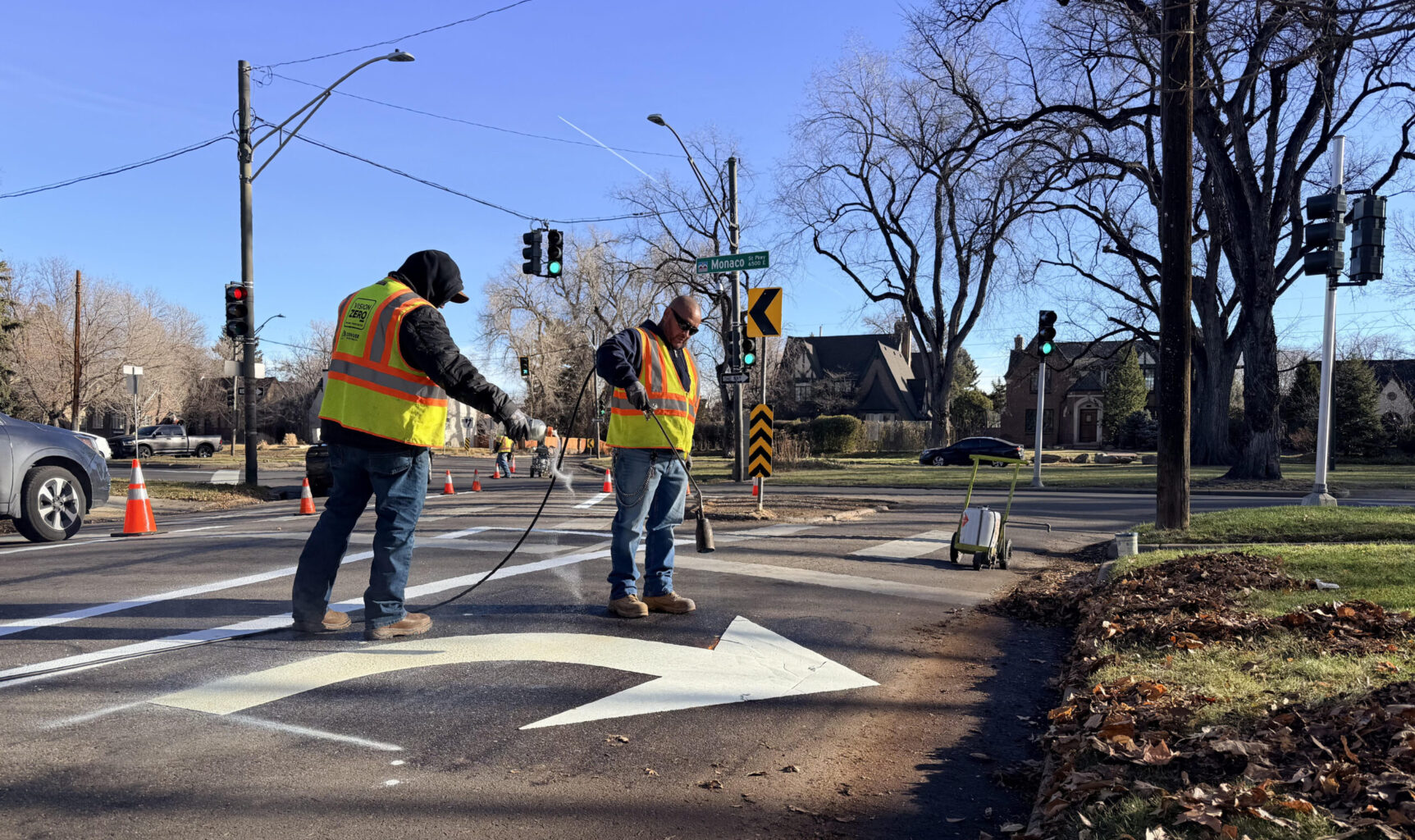
City workers make changes to the roadway in a dangerous intersection in Park Hill.
Stoll said he’s appreciative of the new signage, but said, “Let’s be honest. It’s really just lipstick on a pig.” He believes the problem is speed and that the new signs and paint won’t do anything to slow cars down. A study conducted for the city last December showed that 76% of all cars on 17th Ave. travel at speeds above the 30-mph limit—with some cars traveling up to 80–99 mph.
Thompson said that the signs aren’t likely to deter cars going at those high speeds but said, “If we engineered each of our roads to the standard of someone really breaking the law, our roadways would be way over-engineered, and it wouldn’t be equitable across the city for us to do that.”
In another sign of progress, Watson said the city had reclassified 17th Ave. from an “arterial” street to a “neighborhood collector,” a move that could lead to lowering the speed limit. But Thompson said the limit can’t be lowered unless physical changes are made to narrow the street, and there are no plans for that at this time.
Community members said they will continue to fight for additional safety measures, including speed bumps, protected bike lanes, barriers, and flashing signs.
In the meantime, some are taking matters into their own hands. This fall, Stoll’s neighbor erected a large electronic sign that has flashing red arrows and a message that says, “Please stop hitting our houses.” Stoll, meanwhile, has installed large boulders on his lawn to try to prevent cars from reaching his house.
Thompson said DOTI plans to study the intersection over the next six months to see if the new signage and striping reduce the number of crashes. “Let’s monitor it, let’s see if this works. We do have other ideas in the hopper, should we continue to have problems,” she said.
As to some of the proposals that have been raised by neighbors, Thompson said many are not workable. She said speed bumps aren’t practical for such a busy street: “They end up launching people and causing more problems than they do solutions.” And even smaller pavement impediments bring complications. “We have looked at mumble strips, which are a lightened version of rumble strips,” she said. “But we would have to go through an extensive public process with some of those adjacent neighbors to find out if the trade-off of the noise would be worth it.”
In terms of erecting concrete barriers along the parkway, Thompson said it would involve an extensive regulatory process with Denver Parks and Recreation because Monaco St. Pkwy is considered an historic parkway. She also said that Jersey barriers, or tapered concrete dividers, aren’t appropriate in this kind of setting since they are designed to keep highway drivers in their lanes. “They’re not intended for a 90-degree hit,” she explained. “A 90-degree hit on a Jersey barrier by a car going 50 miles an hour is almost always a fatality.”
Stoll and his neighbors remain frustrated. He is pleased that council members are taking the issue seriously but thinks “the city is just being negligent and not really listening to us and not really taking into consideration that lives need to be protected.”
Watson, for his part, is confident that additional measures will be put in place. “We did it on York Street,” he said. “We used engineering and technology, changing where people turn, and we have seen a clear reduction in homes being struck by cars,” he said.
DOTI’s Thompson said she, too, wants to see reduced accidents. “We’re really all on the same team. We want our streets to be safer in Denver. We do everything in our power to do that. We just have limitations sometimes.”
Front Porch Photos by Christie Gosch
Denver “traffic calming” by erecting 3 stop signs on Montview Bldv between Colo. Blvd. and Quebec ( 1 mile stretch) are contributing over two tons of CO2 pollution each day without offering any meaningful additional safety to one Denver’s already safe streets. Not a sound policy.