

This month’s review is a family-friendly film that will no doubt become a favorite for many years to come. In addition, August brings the return of CinemaQ to the Sie FilmCenter. From the Denver Film Society: “Founded in 2009, the CinemaQ Film Festival was created to leverage the power of film to celebrate queer voices, queer visions, and queer visibility. The three-day festival is designed to showcase the best in new and classic LGBTQ+ cinema from around the world to Colorado audiences.” This year’s festival runs from August 8–10. Tickets and program information can be found at www.denverfilm.org. Hope to see you there.
Flow (2024)
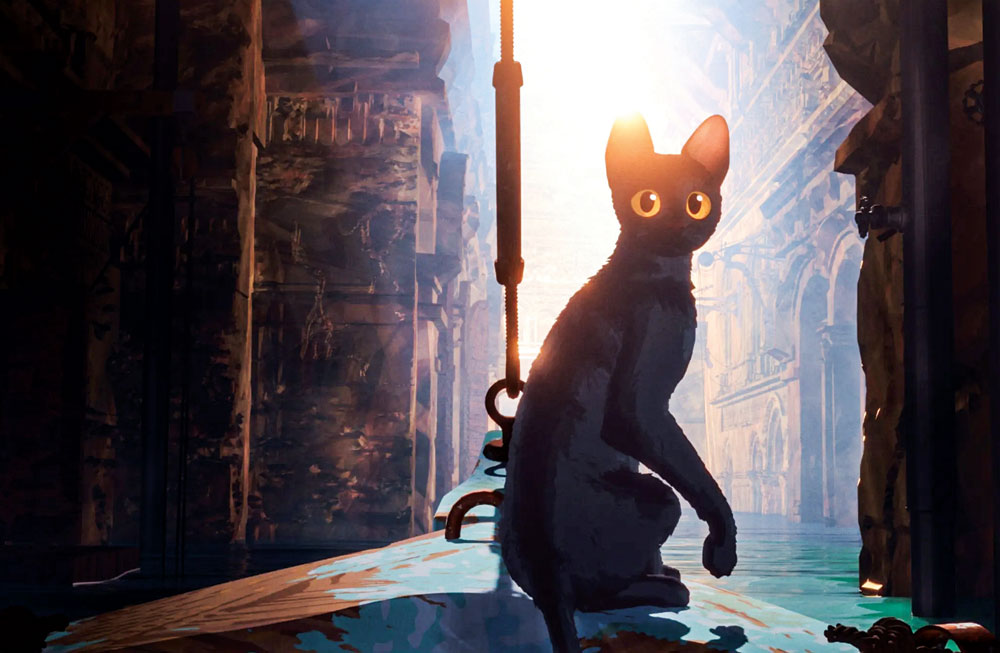
This is one of the most cinematically innovative, gripping, touching, and engrossing films I’ve seen in quite a few years. An animated feature with no dialogue, it is pure cinema: visuals, music, and drama. In addition to the engaging and tension-filled story, the film begs to be read as metaphor.
Flow
The wonderful story centers around a grey cat that is wandering around a human-less and nondescript world. Trees, streams, and bizarre sculptures of cats dot the immediate landscape as our hero dodges dogs and other predators on its travels. The cat lives in an abandoned house, content in a bed by an open window. The landscape quickly changes, however, as a tidal wave subsumes everything. The cat lands on solid ground and finds its way back to the house, but the surrounding water level rises quickly. The cat finds refuge in a boat as the house is overrun by water. That boat is already home to a large, harmless rodent (a capybara—I had to look this one up) that soon falls asleep, indifferent to the cat. Along the way, the boat picks up a dog, a lemur, and a secretary bird (I had to look this one up too), who saves the cat from the bird’s unfriendly flock. The adventures begin.
The story is easy enough to follow, but the visuals are what really astonish and delight. The production took over four years, with the Latvian animators using an open-source program to make the entire film. The detail of every scene is impeccable, while the movement and simulated camera effects are truly astonishing.
I always tell my students to watch films at least twice—the first time to let the story wash over you and the second time to analyze the visuals. This film in particular rewards for repeated viewings. As you watch a second or third time, the tensions melt away (spoiler alert: it ends well) and you notice details such as the light reflected in the cat’s eyes; a deftly moving camera; backgrounds at all levels that provide intricate detail; and mostly, the emotion on the faces of every animal. And remember, the only “dialogue” comes from the animals, such as the cat’s meows and hisses and growls, the birds squawking, the dogs barking, etc. The sound effects round out the world, such as the rushing water, the wind in the trees, the thunder. The overall sound is precise and expressive, and it makes us realize how much dialogue (too much in my opinion) populates most films.
The film won a much-deserved Oscar for Best Animated Feature, and as a testament to its brilliance, it was also nominated for Best International Feature Film. It easily could have won in that category as well. Finish off your summer by watching this one (multiple times, I hope) with kids and/or other loved ones. The allegory at work? You’ll have to wait for the screening at The MCA Cube—coming soon.
Available on HBO Max or rental.
Vincent Piturro, PhD., is a Professor of Film and Media Studies at MSU Denver. Contact him directly at vpiturro@msudenver.com or follow him on X. For more reviews, search The Indie Prof at FrontPorchNE.com.
0 Comments