

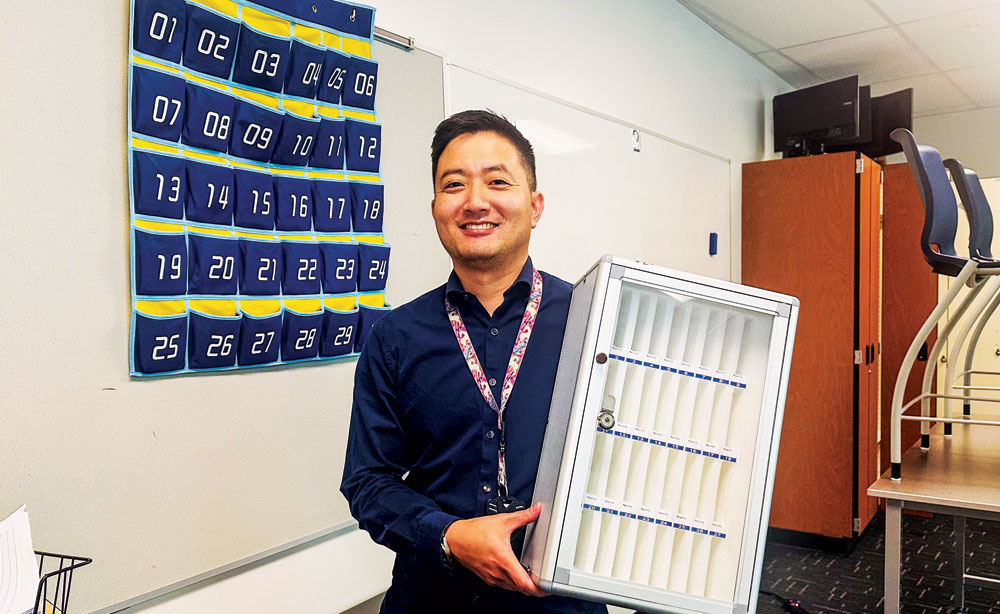
Northfield High School teacher Mark Groves shows two options for cellphone storage during class.
After years of students and teachers navigating varied cellphone rules, a new Colorado law requires school districts to implement straightforward policies for distraction-free learning.
DSST Public Schools—a network of charter schools in Denver and Aurora—and Denver Public Schools (DPS) both updated their cellphone usage policies for the 2025–26 school year, with more comprehensive guidelines in the works for 2026–27.
In DSST Public Schools, under the new policies, students have to keep their phones in their backpacks or otherwise tucked away when in class.
Senior Alya Mohamed doesn’t feel like the rules at her school, DSST: Montview High School, differ much from last year’s guidelines. “They just got a lot stricter in saying we don’t want to see it [the phone] at all,” she said. “At first, I sort of agreed with it. I can see where cellphones can be a distraction.”

While teacher Tatiana Barbic (left) and high school senior Alya Mohamed from DSST: Montview High School, agree on the need for cell phone regulations, Mohamed believes the new law should allow for flexibility.
DSST: Montview High School teacher Tatiana Barbic welcomed the policy change. “I think it is really important that it happened and that students are aware that this is such an important issue that it has been elevated to the state level,” she said.
At Northfield High School (NHS), students are permitted to use cellphones before and after school and during lunch, but similar to DSST schools, usage is prohibited in the classroom. Students are asked to place their phones in containers upon entering a classroom.
NHS teacher Mark Groves said his “initial reaction to the law was ‘good luck.’” He said he believes the law lacks uniformity, making enforcement difficult across districts.
The new legislation reflects concerns from parents, teachers, and pediatricians about students’ use of technology and their mental health. NHS counselor Shelby Clark believes that banning cellphones is beneficial. “We spend a lot of time having to follow up on things like students using their cellphones inappropriately with other students,” she said. “We know that bullying on social media is at a level that is so unfathomable compared to the bullying of pre-smartphone times.”
Some students are worried that the new policy limits their ability to communicate during emergencies or personal challenges.
“I think having your phone is a must during school,” Mohamed said. “You’re not able to call people if you don’t have a phone. A lot of these school shootings are reported because students are calling.”
Beyond safety, Mohamed said access to her phone allows her to tell her parents when she isn’t feeling well or is struggling in class. “School is for learning, and if I don’t feel like I can learn, I should be able to communicate that with somebody,” she said.
While Clark acknowledged that some students feel safer with their phones, she is unsure whether having their devices in hand facilitates overall well-being. “They feel connected to their parents. They can talk to their friends. They know what’s happening in the world. And truly, it is also a two-way door, right? But then all these people and worlds have connections to them. And then there’s a lot of room for there to become a lack of safety.”
Groves called for collaboration and patience among students, parents, and educators. “We are doing our best with what we are given,” he said. “We understand that there are many frustrations and a lot of unknowns, but that this is not a battle.”
Front Porch photos by Christie Gosch
0 Comments