

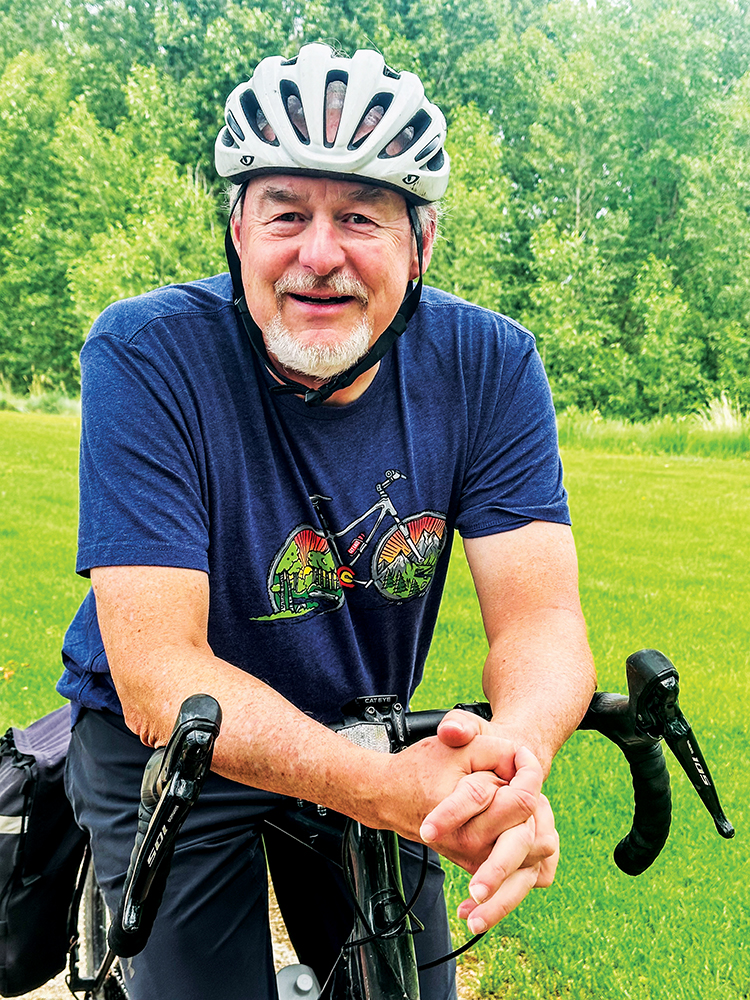
Retiree and bicyclist Ray Landis also enjoys writing. Front Porch photo by Christie Gosch
As an avid bicyclist and a newcomer to Central Park, moving here from Pennsylvania, I was overjoyed by the cycling infrastructure I found here. The miles of trails, the marked bike lanes, and the plethora of bike shops are vast improvements over what I experienced in the Keystone State.
As I’ve explored the Denver area on my bicycle, I have noticed room for some improvement—numerous difficult road crossings on trails, rough pavement in designated bike lanes, and a puzzling lack of north-south bike routes compared to east-west
sectors. But after nearly a year of riding here, I’m still in awe of the accommodations made for bicycles and the many places trails and bike routes go.
Central Park is an ideal location to begin a bicycling habit or to continue to expand your cycling experience. The Sand Creek Regional Greenway is a gateway to short, medium, and long rides.
Newcomers to Denver might be surprised at their first encounter with the trail network anchored in Central Park by the Sand Creek Trail. In many other parts of the United States, white concrete paths are sidewalks which prohibit bicycle traffic. In the Denver area, however, almost all the bicycle trails are concrete, as opposed to a darker asphalt surface. There is an ongoing debate about which surface is better from both an affordability and durability perspective, but the important thing for bicyclists here is these concrete trails are shared bicycle and pedestrian paths.
Of course, most sidewalks are pedestrian-only and prohibit bicycles and it can be difficult for cyclists to figure out when a path is open to bicycles and when it is not. For instance, in Central Park, the sidewalk along Central Park Boulevard from the bridge over the RTD tracks to just beyond Northfield Avenue is a designed bike route. A great source for this information is the Denver Bike Map which also offers tips on cycling safety and regulations.
One interesting cycling law in Colorado is how bicyclists may treat stop signs and traffic lights. It is permissible for bicycles to ride slowly through stop signs after yielding to pedestrians or other vehicles with the right-of-way. Bicycles may also proceed through a red traffic light after coming to a complete stop if there is no oncoming traffic.
An exciting feature of the Sand Creek Regional Greenway is its connection to other bike trails. Six miles west of the parking lot for the trail on Smith Road, the Sand Creek Trail ends at the South Platte River Trail. Cyclists can ride for miles either north or south on the South Platte River Trail, or, by riding one mile north, can continue west on the Clear Creek Trail all the way to Golden.
Two miles east of the Smith Road Parking lot, the Sand Creek Trail enters Aurora. At this point it transitions from concrete to crushed stone, which will accommodate most bicycles. Four more miles along this path and the Sand Creek Trail intersects with the High-Line Canal Trail, which goes north via a bicycle-and-pedestrian-
only bridge across I-70 to the Green Valley Ranch neighborhood, or south, meandering 50 miles or so, to Chatfield State Park.
If you don’t like the crushed stone, take the Toll Creek Trail south into central Aurora, where you can eventually link with the Cherry Creek Trail through Cherry Creek State Park or back into downtown Denver. Aurora has recently made significant improvements to its bicycle infrastructure.
It would take many, many rides to experience all the trails and bike lanes in the Denver area. Experts may claim other cities in the United States are better for cycling, but I believe bicycling here is fantastic. So put on a helmet (please!), find a trail, and explore. Whether you ride 5 miles or 50 miles, you’ll feel better when you’re finished, and you will see things you would never notice from a car.
0 Comments