

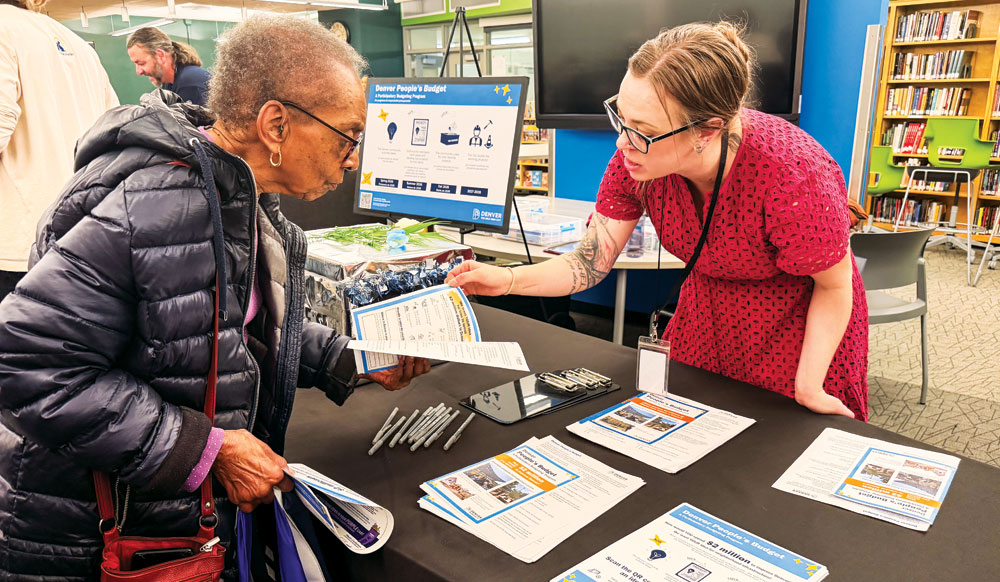
At neighborhood community events, Christin Brandow (right), senior city planner, explained the People’s Budget process to neighbors. Residents are invited to engage on ways to spend money on projects across Denver. Front Porch photo by Christie Gosch
East Colfax residents are shaping how millions of dollars will be spent to improve the city of Denver. The participatory budgeting program, known as the Denver People’s Budget, launched its third cycle in October, giving residents decision-making power over how $2 million in infrastructure funding is allocated.
“The Denver People’s Budget is really empowering people to think about how the government works for them,” said Shelby Morse, marketing and communications director for Denver Economic Development & Opportunity.”
Over the course of 15 months, Denver community members set cycle guidelines, submit project ideas, and refine them into proposals that are placed on an informal ballot for late 2026. Anyone who lives, works, or attends school in Denver can select multiple projects and rank them in order of preference and will be able to vote online or in-person through various community events and partner organizations.
This year, $1 million has been dedicated to neighborhoods in southeast Denver. The remaining $1 million will be used across the city.
Funding is sourced by Denver’s Six-Year Capital Improvement Plan, which requires all projects to qualify as capital or infrastructure investments. City council, in conjunction with the mayor’s office, determines the total funding for each cycle through the annual budgeting process.
Several East Colfax residents participated in the program’s first phase as steering committee members. The group worked together to publish a guidebook that shapes each subsequent phase.
Ross Gothelf, an East Colfax resident, joined the steering committee in hopes of flexing what he called his “civic muscle.”
He was motivated in part by his frustration with how policy choices are being made at the city, state, and federal levels, and he saw the committee as an opportunity to engage directly in community decision-making with people from diverse backgrounds.
“It should serve as evidence that if you trust people to make decisions that are meaningful for them and their communities, they will achieve meaningful outcomes,” Gothelf said.
East Colfax resident Don Deih participated last year as a program delegate, helping to secure $300,000 for shade structures at New Freedom Park, located at 13th Ave. and Xenia St.
She returned this cycle as a steering com- mittee member, advocating for guidelines to ensure East Colfax residents and parkgoers were heard throughout the process.
“We pushed to have kids who are 8 years old and older to be able to vote because the kids know better than us. They are the ones playing,” Deih said. She hopes the program will lead to additional park investments, including water-play access for children and speed-regulation measures along the adjacent street.
The program is now in its second phase, during which community members can submit ideas for how to allocate the funding. The guidebook outlines that any member of the community can submit an idea.
Christin Brandow, a senior city planner, is promoting submissions through various social networks, events, and community outreach.
“A lot of our idea collection comes from going in person to some of the most vulner- able communities in the city. We spent a couple of days going into the downtown detention center and county jail,” Brandow said. “We’re going to some of the micro communities around town or into shelters.”
Nearly half of submissions are collected on paper through in-person outreach, which Brandow said allows residents without reliable internet access to participate in the process.
Brandow’s team is working with the East Colfax Community Collective, Hope Communities, Mercy Housing, and The Fax Partnership to encourage submissions and participation.
More than 300 ideas have been submitted online, with about 30 focusing on improvements in northeast Denver, ranging from facilities for unhoused residents, street safety, and expanded open spaces. The deadline to submit project ideas is March 31. Phase three will begin in May, when a new group of residents, known as project delegates, will refine submissions into formal proposals.
The proposals will appear on an informal ballot later this year.
0 Comments