

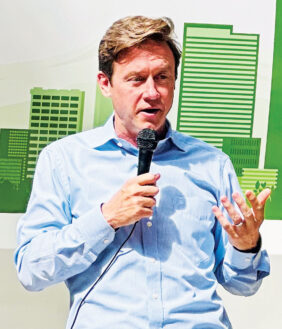
Denver Mayor Mike Johnston.
Even as the City of Denver faces a $200 million budget shortfall in its 2025–26 fiscal period, Denver voters decided to approve $950 million in debt for the Vibrant Denver bond package. Measures 2A-2E were all passed in the Nov. 4 election. The bond will fund infrastructure maintenance and cultural projects across the city.
See results here https://www.denvergov.org/electionresults#/results/20251104
While Denver’s budget and the bond package are separate fiscal issues, there is a common thread. Mayor Mike Johnston believes that the 59 projects included in the bond will serve as a “stimulus to the city’s economy,” benefiting the budget. “A moment of economic uncertainty is exactly the time to do a bond,” he said. The bond projects were approved by Denver City Council in August after a heated discussion about which projects to include and how much to allocate to each. The Denver Zoo Conservation Alliance, for example, requested $50 million to fund a new permanent exhibit, among other improvement projects, but was only approved for $3 million for facility maintenance.
Ultimately, the projects approved by City Council were selected to fuel business, modernize roads and transportation systems, enhance civic spaces, and “keep the economy moving,” Johnston said. All projects are slated for completion within six years.
No Raised Taxes, but Increased Debt
Although the bond increases the debt carried by the city, it does not raise taxes. Nicole Doheny, chief financial officer for the City and County of Denver, explained, “Cities across the U.S. use bonds to fund major capital investments, like new bridges, parks, recreation centers, street redesigns, and other public infrastructure, that would be too expensive to fund out of a city’s annual budget.”
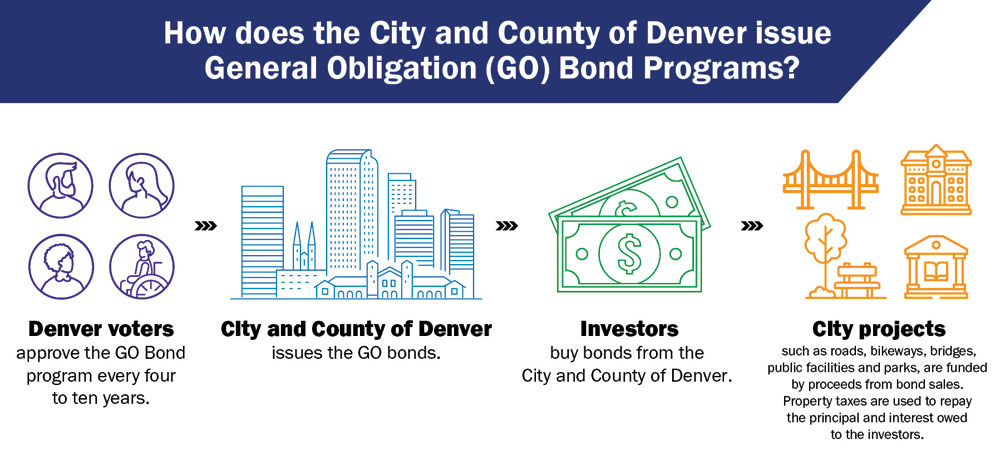
Illustration courtesy of City and County of Denver
Echoing Johnston, she continued, “The city typically looks to infrastructure funding as one way to help support local jobs and economic activity during downturns.” Vibrant Denver is a general obligation bond package, meaning the city borrows money upfront from investors to fund capital projects and repays it over time with interest. The bond would be paid off within 30 years with existing property tax rates.
Johnston compared the bond package to a “honey-do” list. “They’re the things we don’t do on Wednesday, Thursday, or Friday, but when Saturday comes, we tackle all of it,” he said. In the same way, the city’s budget does not cover special projects, but a bond package “gets them done,” he said. Prior to City Council approving the list of projects, the mayor’s office and members of City Council met with about 1,000 community members for input and received more than 6,000 responses to the Vibrant Denver online survey.
Northeast Denver Projects in the Bond
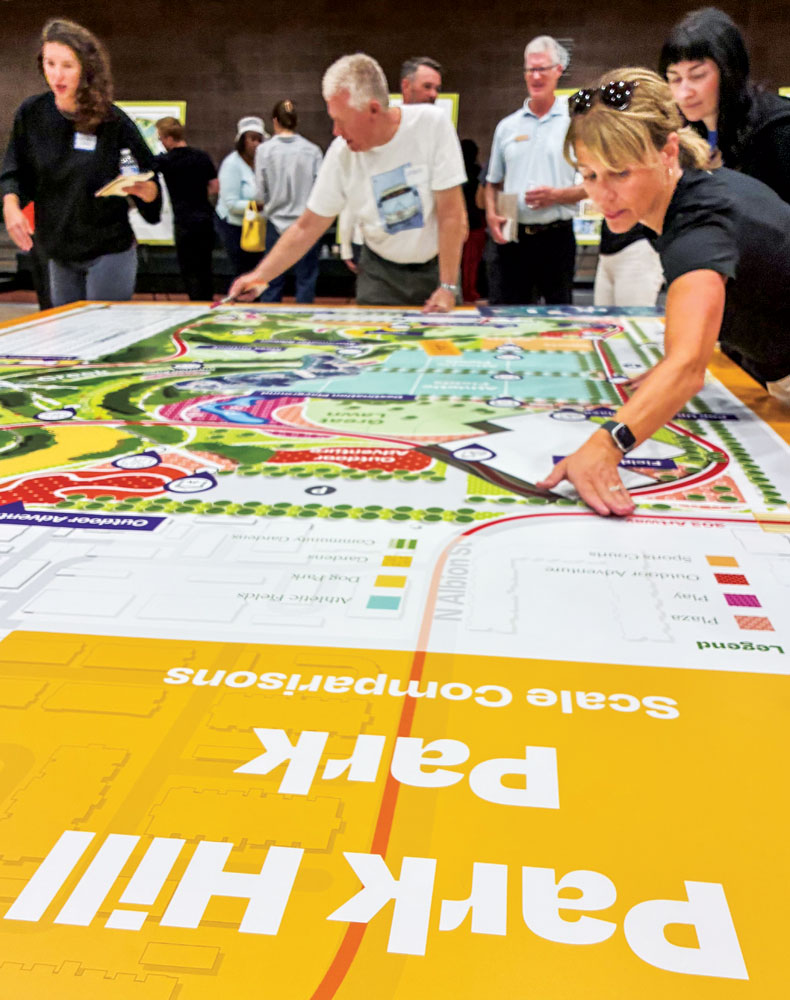
At a recent forum, Denver residents considered potential amenities for Park Hill Park, one of the projects to be funded in the Vibrant Denver bond. Photo by Mary Jo Brooks
One of the most expensive northeast Denver projects in the bond package is Park Hill Park, with $70 million dedicated to developing the regional park. Both the mayor and City Councilmember Shontel Lewis, who represents Park Hill as part of District 8, advocated for its inclusion in the bond.
The park opened in late October and will now receive funding for the community-led project.
Other northeast Denver projects in the bond package are a library for the neighborhood of East Colfax and the 303 ArtWay Trail. Following the City’s new model to use public space to address the affordable housing crisis, affordable housing would be built atop the library, and a recreation center would be attached. “This is also a matter of equity,” noted Johnston. “East Colfax deserves a beautiful library too.”
As for the trail, the 303 ArtWay Heritage Trail will receive $1 million for a proposed four-mile pedestrian and bike loop in Park Hill, connecting the RTD 40th & Colorado station to Holly Square. Funding will support the installation of landmark signage and art along the trail.
In Montbello, the Arie P. Taylor Senior Center will receive a $1 million dollar renovation, and in Montclair, Lindsley Park will be updated.
Transportation makes up nearly half of the costs of the bond. “One of the things we don’t think about until they fall apart are bridges,” Johnston said. The bond package aims to ensure that three Denver bridges, including the bridge on 8th Avenue where traffic has been slowed to 10 miles an hour due to structural concerns, are overhauled. The other two bridges included in the bond are on 6th Avenue and Lincoln Street.
Two additional bridge repairs that the city is pursuing but did not include in the bond package are on Quebec Street in northeast Denver.Since voters passed the transportation measure in the bond, Denver funds (apart from the bond) for bridge repairs will be allocated to the Quebec bridges.
The bond package will also fund street safety improvements for 13th and 14th Avenues. To enhance the Santa Fe Arts District, the bond will allocate $29 million to wider sidewalks, improved public spaces, and safety measures between 6th and 13th Avenues.
The five separate questions on the Vibrant Denver bond voters were asked to weigh in on:
- Transportation and mobility, including rebuilding roads and bridges: $446 million allocated
- City facilities, such as libraries, cultural centers, and a training center for emergency responders: $252 million allocated
- Parks and recreation, including new parks and facility upgrades: $175 million allocated
- Housing and shelter, including subsidy programs, facility upgrades, and affordable housing: $46 million allocated
- Health and human services, including new and expanded facilities: $30 million allocated
All of the measures passed.
Johnston acknowledged that as the City faces economic challenges, “you have to cut costs.” Yet, he said, “like any family facing economic challenges, you need to increase revenue as well. You plant while you’re pruning.”
After reviewing all the individual projects proposed for the bond issue, I can only vote yes on 2B, the park & recreation capital investments/repairs. I will be voting NO on 2A, 2C, 2D, and 2E. It’s time to pay down our overall bond debt in the hopes we can finally get the savings back in our property taxes. They promote this as no new taxes, but what they fail to tell you is that absent any new General Obligation Bonds, the debt will be paid off in X years. But with the new debt you are putting yourself on the hook to keep higher property taxes assessments going for another 20-30 years. If we pay down our current debt levels, the savings going from lower property taxes help your family budget during this uncertain economy. Many of the large dollar projects only cover the initial phase of the construction where larger subsequent amounts will be needed to complete the project.