


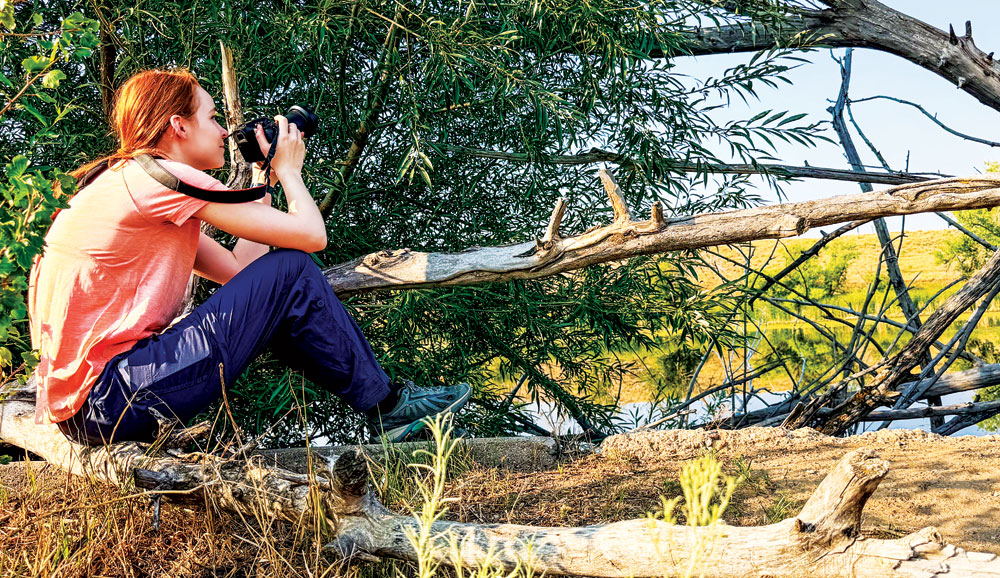
Freya Williams, age 18, started birding during the pandemic. She drove 20 minutes to Bluff Lake Nature Center to catch sight of a green heron that had been spotted there. While the bird was elusive, she saw and photographed other birds around the lake. Front Porch photo by Christie Gosch
On any given day along the trail at Bluff Lake Nature Center in Denver, neighborhood runners and walkers are making their morning loops around the lake. In increasing numbers, birders are also there, sporting binoculars, cameras, and phones, with eyes to the treetops and shoreline.
Birding, or birdwatching, is a hobby that has grown. The U.S. Fish and Wildlife Service puts the number of birders at 96 million Americans, or more than a third of adults.
“The pandemic was like a stress test that forced people to go outdoors, and one of the very common activities is birding because it’s not expensive,” said birder George Ho, a regular visitor to Bluff Lake. “If you have the right equipment, you can just go to parks and nature centers and reap all the benefit of being outdoors.”
Birding isn’t age-specific and can be done solo or in a group. And Ho said there are various levels to choose from, ranging from very casual to more serious watchers who keep a life list of birds they see.
Lists contributed to the Cornell Lab of Ornithology are used to gather data that Ho called vital information and general knowledge for everybody.
“Birds are really important as far as being the canary in the coal mine,” he said. “They reflect the health of this planet. I always tell people that if you wake up in the morning and you don’t hear seabirds, then you know it’s (the planet) in trouble. We’re in trouble.”
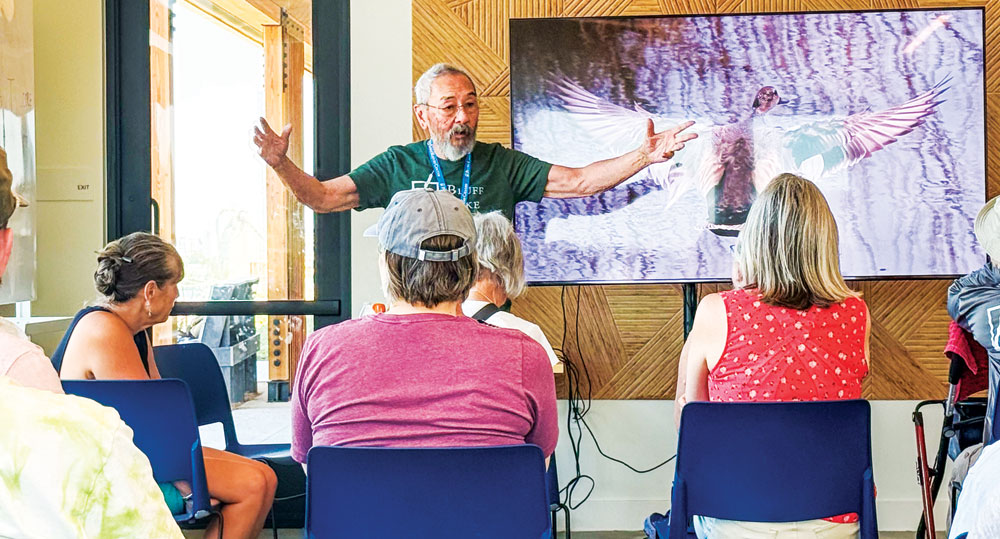
George Ho shared his photos and expertise at the first Armchair Birding session in August. The monthly meetings offer an inclusive experience. Front Porch photo by Linda Kotsaftis
Ho, who calls himself a casual birder, writes for Front Porch and leads monthly bird walks along with six or seven other volunteers. He spends a lot of time with birds—time he didn’t have as a working physician.
“When I retired in 2013, I invested in a camera, and I was lucky because Merlin, the photo ID (app), followed by the sound ID came along, and those are modern tools that will help you to learn the sound and the images of birds without using a field guide. I taught myself.”
The monthly walks at Bluff Lake have grown since Ho joined them there 20 years ago. He said the group was originally small with six to 12 people. Members would meet the first Saturday of the month in the heat of summer and the cold and snow of winter. The bird walks became more popular and exploded after the pandemic, with 60 to 80 people signed up spread amongst four to six groups of birders.
And it’s not just organized walks. On an August morning, a small group gathered at the end of the dock at Bluff Lake. An American avocet was spotted, and even the summer camp kids knew this was a unique sighting. “It’s our lucky day,” one camper said as he and the others listed off all the animals seen that morning.
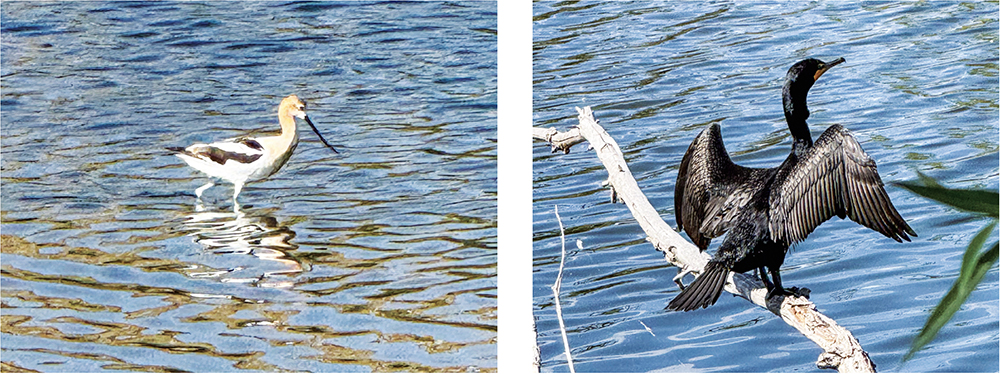
Left: An American avocet enjoyed a cool dip at Bluff Lake Nature Center. Right: A cormorant spread its wings on a hot summer day. Front Porch photos by Linda Kotsaftis
And along the nearby trail, birders pulled off to the side, asking the common question here, “Did you see it?” while sharing images in their camera viewfinders of a cormorant spreading its wings.
Birding, Ho said, “is no different than shopping.” He added, “The quest in birding is not looking for a specific dress or garment. It’s looking at what you can see out there. Birdwatching teaches people that every time you go out, the experience is going to be different. You never know what you’re going to see when you turn the corner; that’s the excitement and the reward. And you always come back having seen something interesting, something unusual, something unexpected.”
And while birding is an inclusive activity, there are still some barriers, which prompted Ho to start a new program at Bluff Lake, Armchair Birding.
“It’s always been in the back of my mind to provide something for the people who may have mobility issues,” he said, acknowledging there are others who can’t be in the sun or aren’t comfortable outdoors and are “missing out.”
As a photographer, Ho wanted to recreate the experience of birding so others could enjoy it vicariously through a slide show. In its first meeting in early August, 20 people showed up to experience birding from inside the nature center building.
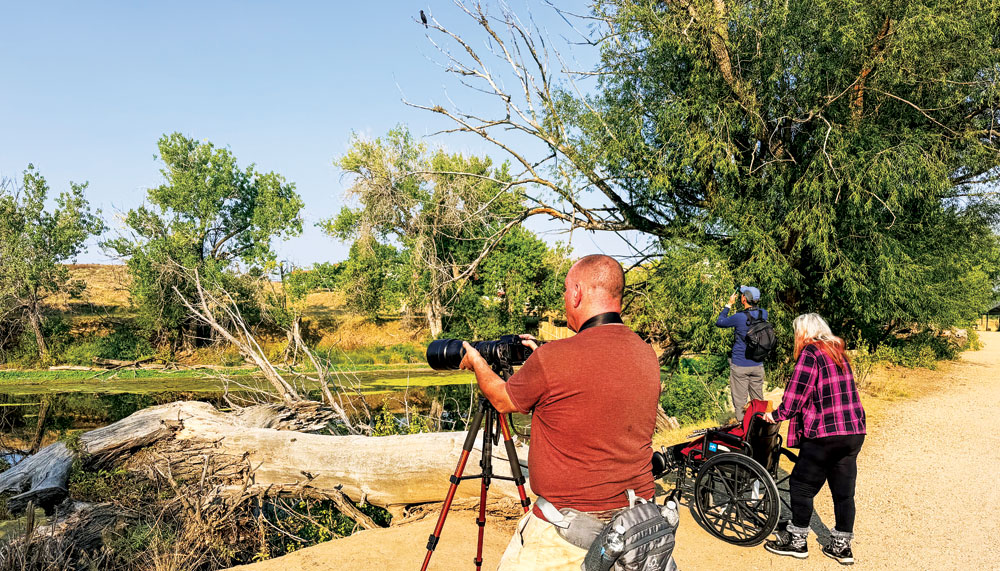
Birder Donald Morse, foreground, was out early one morning at Bluff Lake Nature Center looking for a green heron. He, and the other birders, did spot a cormorant up high in a tree. Front Porch photo by Christie Gosch
Central Park resident Judith Pettibone, who lives near Rocky Mountain Arsenal National Wildlife Refuge, said she joined the Bluff Lake group because she wants to get into more birding. “I want to do more, and I just don’t do really great in the heat, so I didn’t want to come to the bird walk,” she said.
Pettibone and others in the attentive group followed along as Ho ran through photos of birds and quizzes about recognizing different birds—some of the more than 10,000 bird species worldwide.
The next armchair session is Sept. 5 at 10am. Ho is quick to point out that everyone is welcome: There aren’t armchairs, but there is enthusiasm for the love of birds.
“How you appreciate birds is what makes you a birder,” he said.

0 Comments