

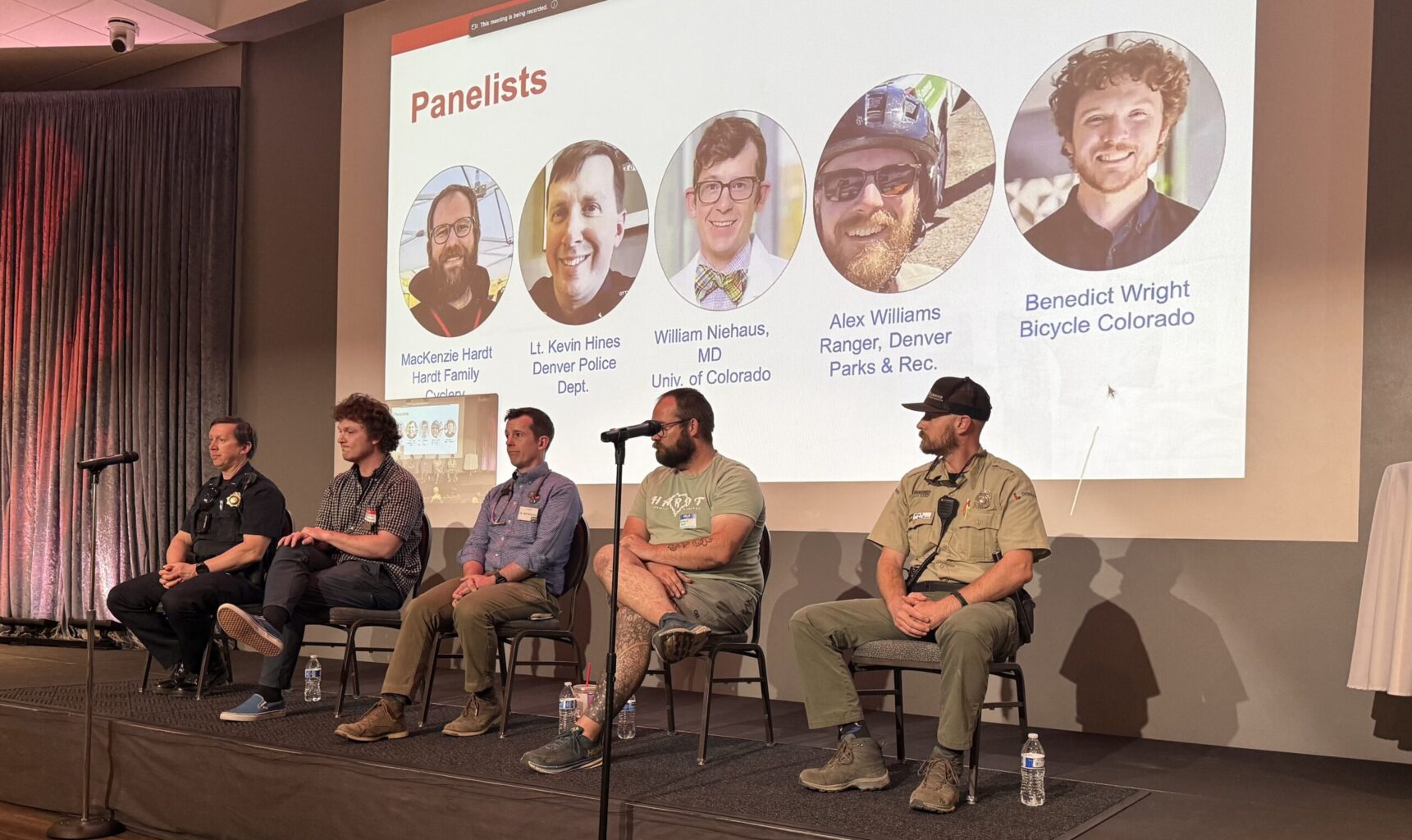
The panelists at a e-bike safety meeting (left to right) Denver Police Lt. Kevin Hines, Benedict Wright of Bicycle Colorado, Dr. William Niehaus, bike shop owner MacKenzie Hardt, and Denver Parks and Recreation ranger Alex Williams.
The conversation at an April 21 gathering centered on what Liz Stalnaker, the Central Park United Neighbors board president, called a way of addressing the “free-floating anxiety” in the community about e-bikes and safety.
The purpose of the event was to create a shared vocabulary and understanding around the topic.
A show of hands started the meeting, entitled E-Bikes & Safety: A Community Panel, at the MCA Cube. The crowd was asked, “How many people own a bike or e-bike?” Hands raised across the room. “And how many people drive a car?” This time even more hands went up.
Carol Hunter, vice president of the CPUN board, then told the audience, “Raise your hand if you walk on public streets. Push a stroller. Use a wheelchair.”
This time, there was a sea of raised hands. “There’s no hierarchy,” she noted. “Everyone has a stake in being safe.”
The panelists were bike shop owner MacKenzie Hardt, Denver Police Lt. Kevin Hines, Dr. William Niehaus, Denver Parks and Recreation ranger Alex Williams, and Benedict Wright of Bicycle Colorado, a nonprofit that advocates for safe, accessible bicycling for all.
Sales
The numbers were introduced first. E-bike sales continue to grow, with 975,000 sold in the U.S. in 2024 and more than 10,000 rebate redemptions in Denver in the same year. But the rise in popularity has caused some confusion for residents who attended the event.
So, there was first an explanation of Colorado’s three-class system for e-bikes, distinguished by speed and functionality, and the differences among e-bikes and e-motos, electric mopeds, electric motorcycles, and electric dirt bikes, which don’t have pedals and require registration and licensing.
Safety
Safety was the main concern for Niehaus, a board-certified brain injury specialist and associate professor in the Department of Physical Medicine and Rehabilitation at the University of Colorado Anschutz School of Medicine.
“If you’re on a device that can go faster than you can run,” he said, “you should wear a helmet. Period.”
Neihaus said that week after week, he sees the consequences of head injuries from bikes, scooters, and other electric mobility devices.
“There isn’t a week,” he said, “we don’t see a brain injury from something like this.”
And it’s not just kids, he said. Neihaus talked about seeing families riding on their bikes, and all the kids have helmets, but the parents don’t. “It feels like they’re saying their brains don’t matter.”
Hardt, owner of Hardt Family Cyclery, added, “The numbers are scary, but reality might be worse.” He stressed the need for riders to find the right helmet with the right fit.
Enforcement
Williams, the Denver Parks and Recreation ranger, spoke from an enforcement perspective, reminding the audience that e-bikes are welcome on city trails but e-motos are not.
“If you ride an e-moto on a trail,” he explained, “we treat it the same as driving a car there.”
He said education is critical for riders and other people using the trails. He suggested residents call 311 or the non-emergency police line if they see someone speeding or riding on grass areas.
Hines, the Denver Police lieutenant and an avid cyclist, brought the conversation back to the roadways. Legally, he said, bicycles and most e-bikes are vehicles. That means riders are expected to follow the same rules as drivers.
He reminded the audience about the safety stop law, which allows cyclists to treat stop signs as yields and red lights as stop signs when other traffic isn’t present. He said many drivers and even some cyclists don’t fully understand the law.
“Share the road,” he said. “That’s the bottom line.”
Wright described a common and dangerous scenario: a car and a bike stop at the same intersection. The light changes. Both move forward. But the driver doesn’t anticipate how quickly the e-bike can accelerate.
“They don’t realize that bike can hit 20 miles per hour almost instantly,” he said.
In that moment—often in a blind spot—the rider disappears from the driver’s awareness. And that’s when collisions happen.
Benefits
The meeting was not without looking at the positives of e-bikes, including accessibility.
Hardt said he sees people getting on bikes who never thought they’d be able to because of health problems, allowing people to “get out and go further and ride more often, especially in the pedal assist.”
There are mental and physical health benefits because e-bike riders will ride every day instead of once or twice a month. And there are cost benefits when compared to buying a car, paying for insurance and registration fees.
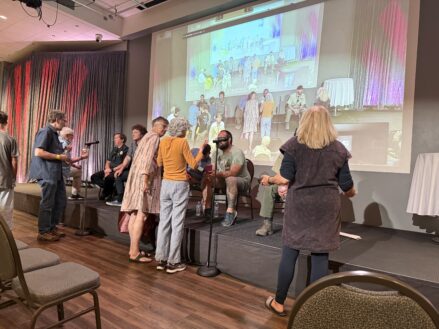
Central Park residents asked questions of the panelists following the meeting.
Wright, of Bicycle Colorado, added youth to the accessibility conversation. “I know youth and e-bikes and e-motos are the source of a lot of consternation amongst a lot of us, me included,” he said, but it’s also worth talking about e-bikes as a way for youth getting outside to socialize, “riding the way that maybe we wish they would, or we remember doing when we were younger.”
People who weren’t able to attend or want to learn more about the topic can watch the full video of the meeting on the CPUN YouTube channel: tinyurl.com/FPBikeForum
0 Comments