

Christina Foust, PhD
The weather of late has been unsettling. The Old Farmer’s Almanac had forecast “above normal” winter temperatures, with normal to near normal precipitation. Unfortunately, as Denverites know, the reality was much starker.
In March, children began playing in the alleyways after dinner as though it was July. People strolling through Central Park crossed to the south to avoid a hot sun, and we heard the rattle of air conditioners as part of the early spring soundscape. I saw folks out tending to their trees and grass, wondering how their plants would fare under watering restrictions when summer actually hits.
As a colleague remarked, this winter is proof that we cannot respond to climate change by sticking our heads in the sand. Or, to move this metaphor from ostrich to human behavior, this winter should be a wakeup call that we cannot “air condition” our way out of global warming.
For decades now, scientists have named a two-pronged approach to climate change:
- Work to mitigate or reduce greenhouse gases fueling the wild swings in our climate, and
- Prepare systems (and the people who live within them) to adapt to the wild swings.
Since Green Simple Living began, we’ve explored ideas that, if practiced, would mitigate and promote adaptation. To our list I will add making smarter cooling and heating choices in our homes.
We already know heat pumps are a good investment for the planet and the pocketbook during winter months. This is true for spring and summer, too, because the heat pump’s efficient action works all year. With Xcel Energy’s new variable rate structure, heat pumps can save homeowners money because they may not even have to run during the peak hours of 5–9pm. If a heat pump isn’t in the budget, a smart thermostat can help.
So, too, can following the Department of Energy guidance of setting your thermostat at 78 degrees in summer (and 68 for winter). Yes, I said 78 degrees. If you’ve never tried to deviate from the arbitrary norm of 72, I invite you to start when you first shut the windows and turn the AC on. Set the thermostat at one degree higher than you think you may tolerate and see how it goes.
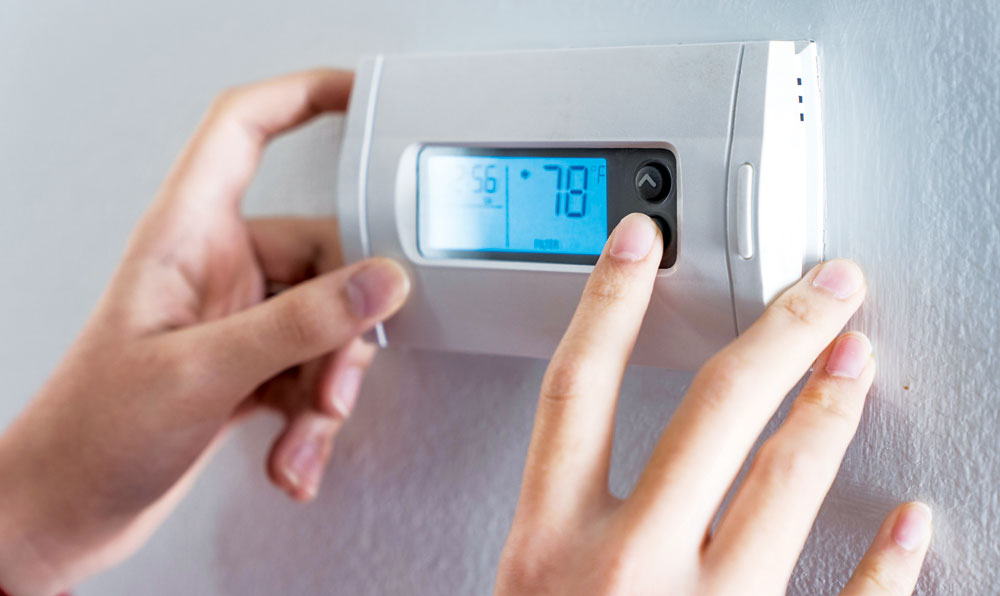
The Department of Energy suggests setting your AC to 78 degrees. Adobe Stock photo
After all, as Sam Bloch explains in his book Shade: The Promise of a Forgotten Natural Resource, many studies find that comfort—the perception of feeling cool or warm—is more about contrast than an exact number. In Bloch’s words, “Coolness never feels better than when we are warm.”
Bloch also describes how people have adapted to hot, sunny environments for tens of thousands of years. They build smarter, using geometry to shade entire walkways and marketplaces. They work, play, and rest smarter, taking to porches and parks for downtime and sleep and adjusting their busy times to fit the sun’s schedule.
Getting the human body outdoors more in heat (especially shaded warm days) helps reacclimate our thermoregulation: U.S. military studies show, for instance, that the body’s tolerance for heat grows after just 10 days of outdoor exercise. Obviously, common sense caution tells us that not everybody can, or should, experiment with building heat tolerance. But as with starting your AC one degree higher than you think you can, we may surprise ourselves with the cascading effects of mindful action.
So for the heat waves that certainly lie before us in what remains of 2026, I invite us to be unsettled, to mourn the loss of a “normal” season. But I also invite us to spend at least as much time and energy being responsive to this moment as we do cursing it. Advocate for more shade in our shared spaces and do the work of planting and caring for trees, sun canopies, and structures. Convince those who run hot in your home to run a fan at night or open a window. Try adapting as a first move, rather than pushing a button to yield instant comfort.
0 Comments