

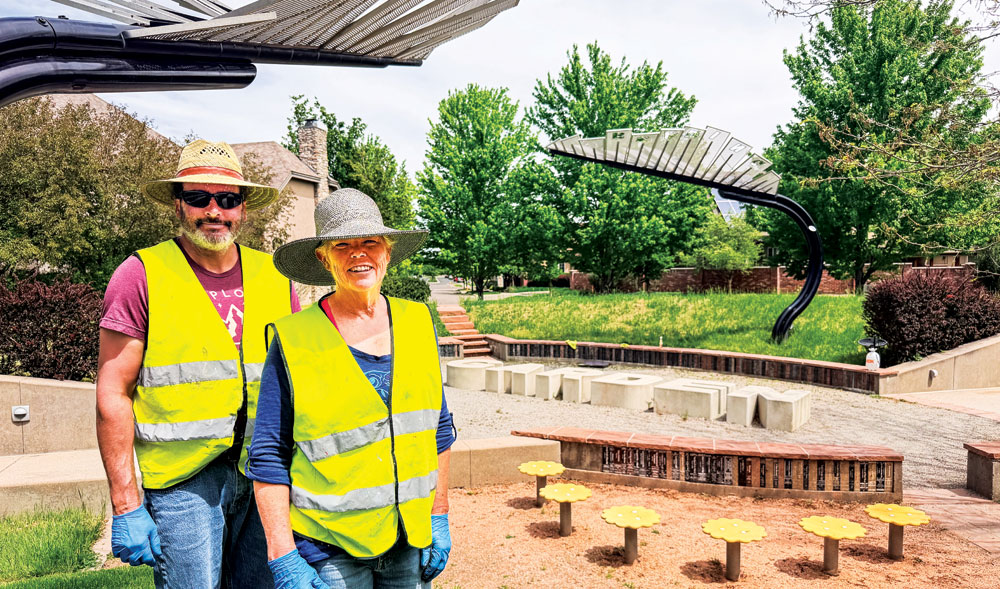
Robert Mutch and Reven Swanson worked at the Lowry Reading Garden in mid-May, part of a project to clean and polish art works in the area. Front Porch photo by Christie Gosch
The sun, heat, pollution, and magnesium chloride used on Denver’s roads are relentless forces against outdoor art. But in the Lowry neighborhood, an effort is underway to protect the sculptures and installations that help define the community’s identity.
“Art creates an entire culture and a neighborhood,” said Reven Swanson, an artist and conservator hired by the Lowry Foundation to evaluate and maintain the neighborhood’s public art collection. “It creates an atmosphere that really encourages community. It gives a sense of place.”
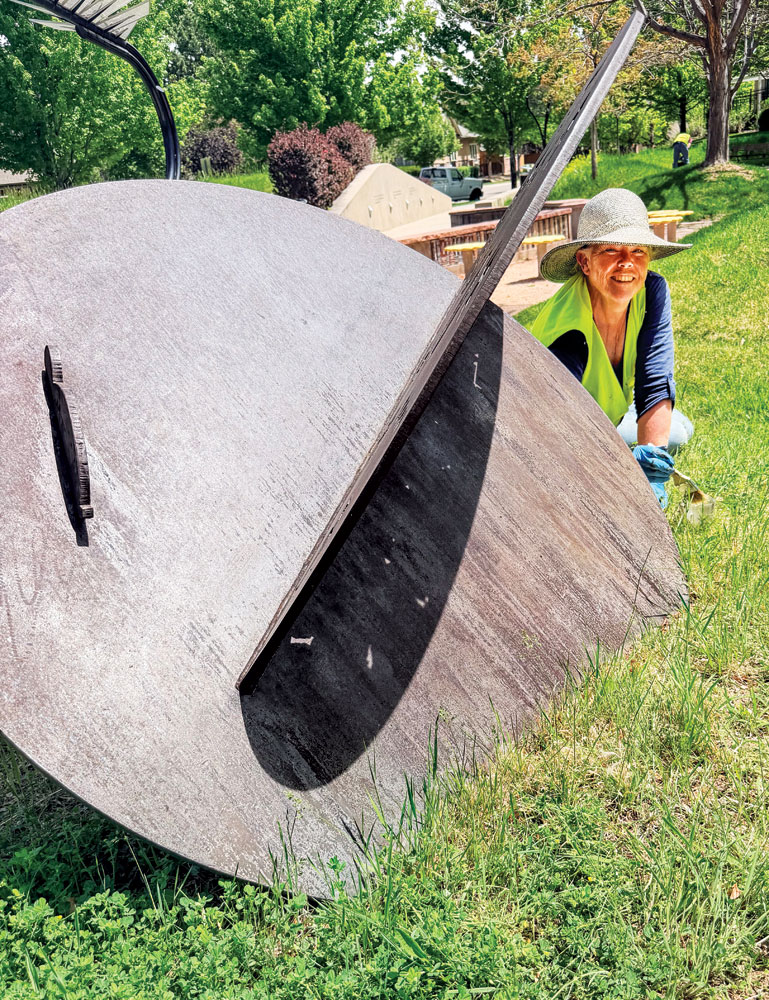
Reven Swanson worked on a sculpture in the Reading Garden in Lowry. Front Porch photo by Christie Gosch
The Lowry Foundation, a nonprofit established in 1998 during the redevelopment of the former Lowry Air Force Base, oversees 13 public artworks spread throughout the neighborhood at bus stops, parks, and open spaces.
“In Lowry, things are very specific with respect to the historical nature of the former Lowry Air Force Base,” said foundation board member Tim Vacca. “So much of the artwork reflects some of that history.”
Swanson’s role combines her technical expertise with her own work as an artist. “It is specialized work,” she said. “There’s just not a lot of people in town who do that.”
In addition to conserving the collection, Swanson’s sculpture, Aspens and Moon, is located in Tailwind Park at 5th Avenue and Alton Way. Her work also appears in communities across Colorado.
Vacca sees Swanson as an example of “getting the right people involved who know what needs to be done. The preventative piece is so important.”
The board does an annual assessment of the neighborhood art collection, noting the condition of pieces and keeping track of what’s becoming a bigger problem. Then Swanson goes to work on graffiti removal, power washing, fresh paint, deep cleaning, protective sealing, and the replacement of worn materials—all essential to extending the lifespan and integrity of the artworks. Her primary focus is to mitigate environmental impact on a sculpture.
“Just imagine what your car would look like if you never washed it. Art is the same,” Swanson said. “You can’t put gutters on a building and never clean them. To conserve art is, to me, to identify the original intent” of the artist.
Vacca admitted that protecting art is not the “sexiest cause.” People don’t necessarily want to donate toward conservation efforts, and the board’s biggest challenge has been financing the work. “Luckily, we’re in a position right now to be able to have an annual maintenance plan,” he said. “Of course, we would love more support from the community.”
He said they’re fortunate to work with Swanson, who lives in Park Hill and regularly rides her bicycle through the area. She said she’s always looking at areas and wondering, “What could you do with this space?”
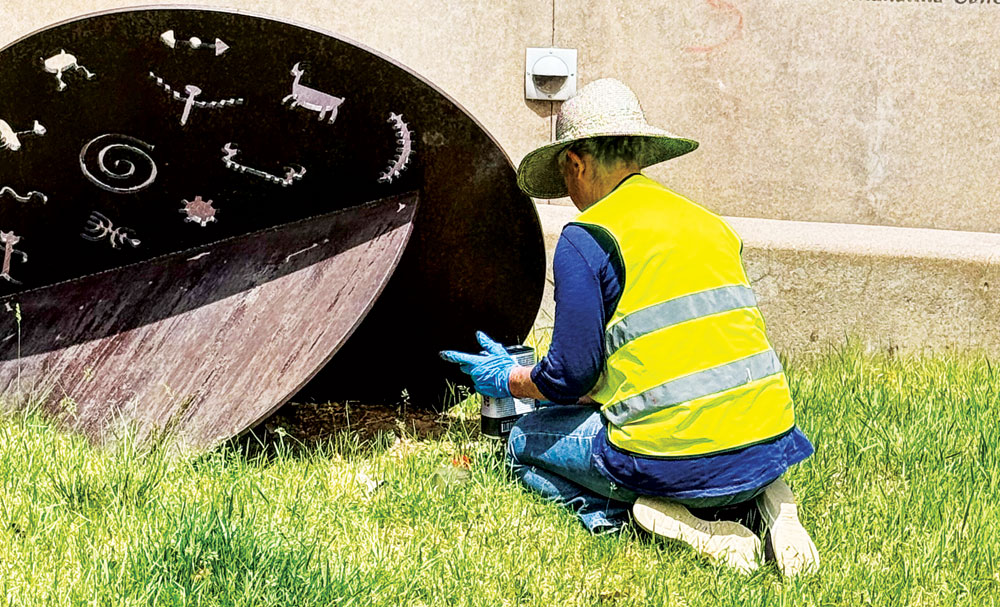
Swanson cleaned the metal sculpture to restore its original form and color as she aims to preserve the art and the artist’s intent. Front Porch
photo by Linda Kotsaftis
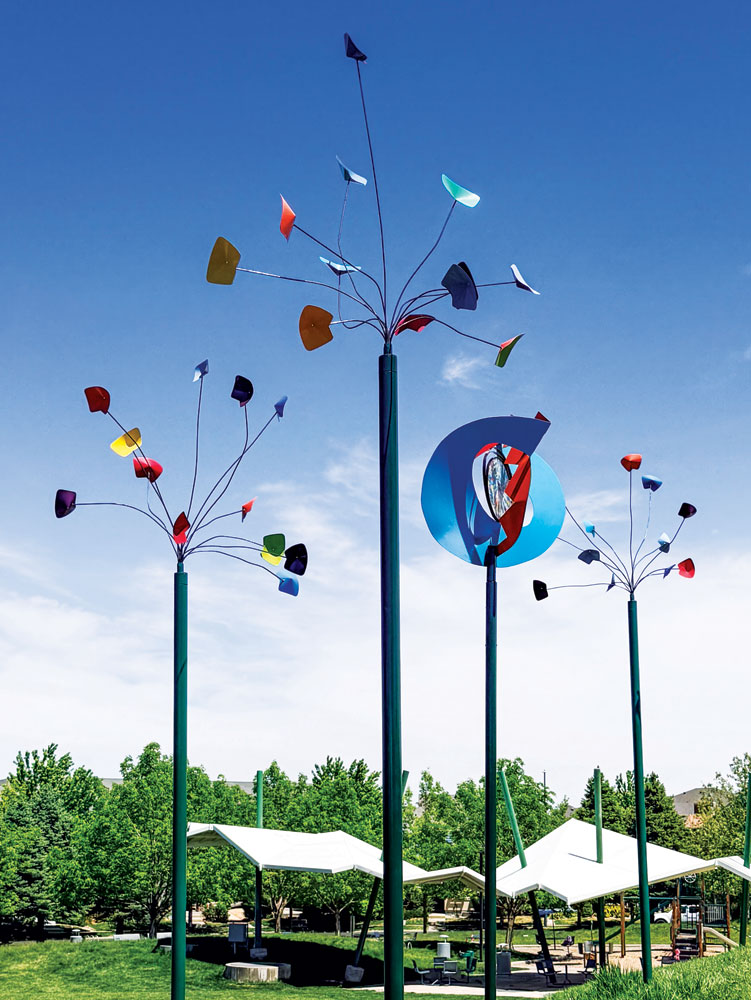
Swanson’s sculpture Aspens and Moon, in Tailwind Park at 5th Avenue and Alton Way in Lowry, is one of her many artworks around the state. Front Porch photo by Christie Gosch
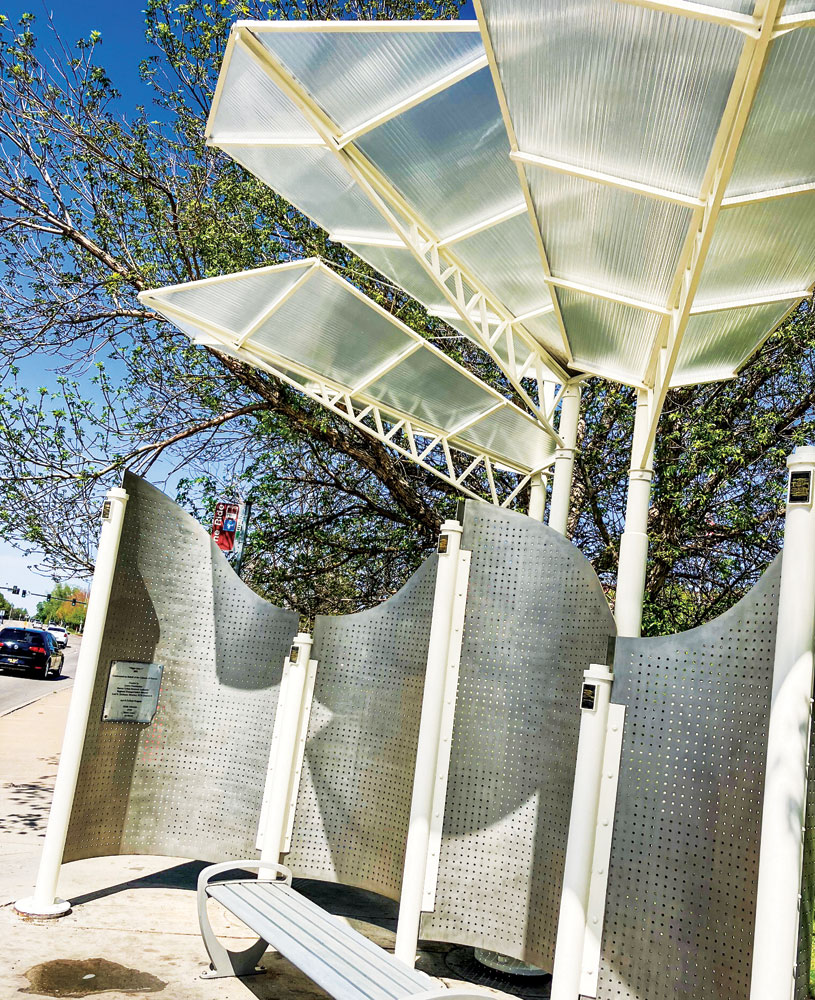
Flight Ride I at 1st Avenue and Quebec Street is one of three sculptures at bus stops being preserved in the area. Swanson said people came up to her to thank her for the work there. Photo courtesy of Lowry Foundation
Swanson thinks a lot about spaces and art and how to avoid what she called “plop art” or art that doesn’t fit an area. “It doesn’t have to be historical. It has to advocate for something. It has to have a reason,” she said.
For now, Vacca said they’re not considering adding any new pieces. “We’re just trying to deal with what we have and be able to maintain that well. We want the pieces to stay. You don’t want to get them to a point where you can’t save them.”
On a hot morning in mid-May, Swanson and her partner, Robert Mutch, were out at the Lowry Reading Garden, painting the fence, cleaning, and working on the pieces. She was where she likes to be: in the community.
When she’s working, people frequently come up and say, “Thank you for doing that.” At a nearby bus stop, one of three that host art installations, Swanson finished painting a trash can when a woman came by and said, “Oh boy, that’s going to look so much better.”
Art, Vacca said, is “a feel-good thing,” and it can also have an economic impact. “People want to be in places that have culture and art, maybe shop or eat and spend some time and money there. So it does have an economic impact, not to mention it supports artists.”
He said it’s important for the foundation to communicate to the community what they do to conserve Lowry’s art as well as the historic Eisenhower Chapel.
The building was donated to the foundation in 2008 by the Lowry Redevelopment Authority and moved to the Town Center area from another location on the Air Force base. Originally, it was one of three similar chapels in the area, but it was the only one kept because President Dwight D. Eisenhower regularly attended services there during his frequent visits to Colorado. A nameplate now bears his name.
Over the years there have been grants to help redo the exterior of the building, including one from the Colorado Historical Society to replace the roof last year.
Overall, the Lowry Foundation’s mission is to preserve art, history, and community spaces.
“I think art should be present in everyday life and everywhere we go as humans, especially in public,” Vacca said. “It’s nice to have those little tickles.”
For information about the art collection and chapel, visit lowryfoundation.org.

0 Comments