


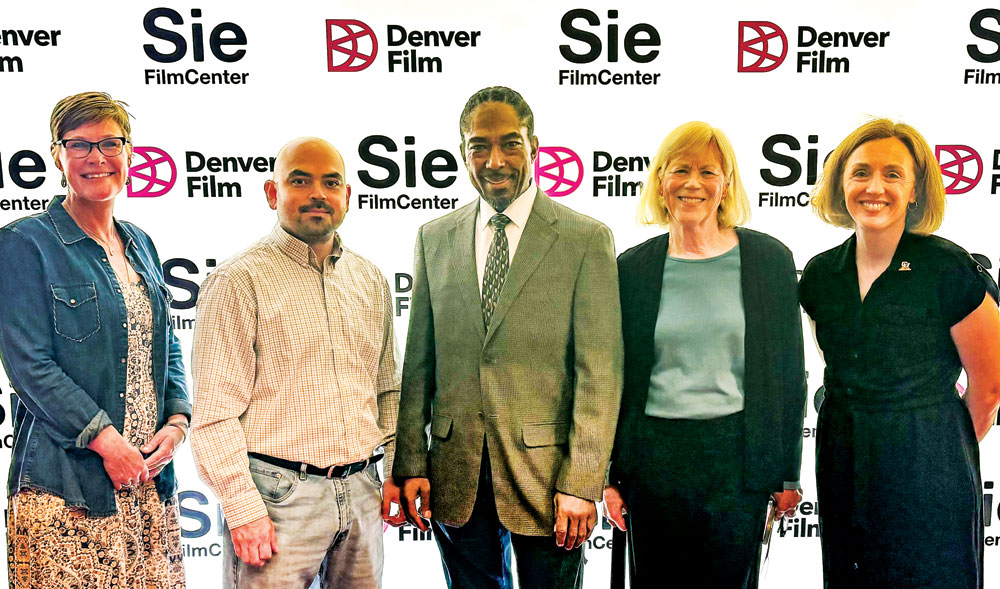
(Left to Right) Kirsten Wulfsberg, Edgar Antillon, Johnnie Williams, and Amanda Wilcox joined Dr. Emmy Betz for a screening and discussion around the film Tennessee 11.
Dr. Emmy Betz had just finished a shift in the UCHealth University of Colorado Hospital emergency room when she talked to Front Porch, and she was a few days away from hosting a documentary screening and panel conversation in Denver.
It was an event that she believes will be “a piece of a bigger story, which is that there’s a hopeful way to get beyond paralysis” on the topic of firearm rights and safety.
Betz is the is the director of the University of Colorado Firearm Injury Prevention Initiative (FIPI), a non-legislative group housed in the CU School of Medicine on the Anschutz Medical Campus in northwest Aurora.
The mission of FIPI, launched officially two years ago, is not to take on gun owners or gun control groups, Betz said. “It’s not to tell people they should or shouldn’t own guns.” Rather, the group’s mission is to help prevent firearm-related injuries and deaths in homes and communities across Colorado.
“It’s not just about locking up guns, but it’s about how we engage with community organizations and with youth and provide the programs that are respectful and based in science. We think about gun violence across the spectrum from gang violence to suicide… There are different ways to prevent each, and different stakeholder groups that we work with,” she added.
Betz got into the work after losing a family member to firearm suicide and from working in the ER where she sees the impact of gun violence.
“I’m tired of that preventable violence,” she said. “And I’m certainly tired of the mass shootings. Although they’re a smaller number in terms of the impact of gun violence, the psychological toll is just awful.”
Betz added that suicide accounts for about 73 percent of gun deaths in Colorado.
FIPI’s work is based in science and in partnerships with the community. “As a doctor, if I’m working with someone who has firearms at home, I don’t want anybody being hurt by them,” Betz said. “So how do we talk about it in a way that is respectful and hopefully going to be effective for them, in terms of thinking about, ‘How should I be storing them at home?’ Or, ‘How should I be locking them up?’”
The film shown at the June event, The Tennessee 11, is the story of a group project that brought together voices from across the spectrum of gun rights and safety with a common goal. The project in the movie is an example, she said, where people were trying to develop policy, law, and solutions that they could all agree on.
The event was the first of its type by FIPI with the hope of bringing in new people who might be interested in the type of work the group is doing.
“We felt like it was a great way to show people that it is possible to come together and learn from each other,” Betz said. “Not to say that it’s easy, but that there’s a way to make progress and in a space that can feel really polarized and paralyzing.”
Betz said FIPI is happy to join smaller community events at schools or churches, and host smaller discussions at restaurants or homes to help people figure out their individual role in helping to prevent firearm injury and death. That role, she said, can be based in science and evidence, but is also based in “respect for other people and respect for a diversity of views and learning how to have sometimes-uncomfortable conversations in a way that moves us all forward.”
The idea is to have civil discussions where people truly listen to each other. “It’s not about talking points. It’s not about politicians yelling at each other. It’s really an attempt to listen and learn from each other so that we can get to that place which we all want, which is people not being hurt and injured. We welcome people of any background who are willing to engage in that kind of respectful way,” Betz said.
FIPI works with the firearm-owning community, traveling to gun shows around the state to provide education and locking devices, and to talk to people about secure gun storage at home.
Research support is also provided to community-based organizations that do youth violence prevention, including hospital-based programs at UCHealth, Denver Health, and Children’s Hospital Colorado. Researchers also work with organizations that serve people experiencing domestic violence.
Betz said FIPI works with communities in the “way they want us.” Trainings are offered for public health leaders. The program talks with policymakers and legislators, and although it doesn’t directly lobby, FIPI is “happy to provide some of the evidence for or against things,” she said.
The program also works with the state Office of Gun Violence Prevention as an academic partner helping to develop resources.
Betz’s work has reached a national stage, but she said she’s a Denver girl who loves working for her city and state. She knows there’s a lot of stereotyping that goes on in Colorado about gun violence in terms of neighborhoods or areas, but she said that “at least 40 percent of people here live in a home with a gun.”
That statistic is something that hits home with Betz, a Central Park mother. “It’s really important that we think about when our kids are in other homes what they have access to,” she said. She added that it’s important that conversations about “Do you have any unlocked guns that my kids could access?” become common.
“Those kinds of things feel scary, but we need to get used to them,” she said.

0 Comments